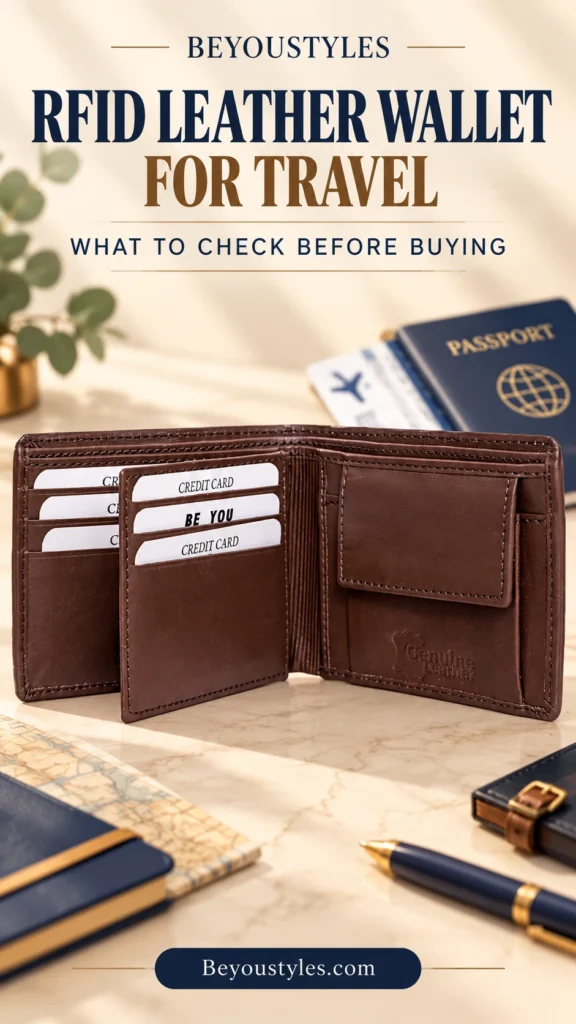
An RFID leather wallet for travel should make your cards and cash easy to carry while offering the RFID-blocking feature you want. Before buying, check how the wallet fits your pocket when loaded, whether it holds the currency you will use and what the seller actually says about card compatibility.
A useful travel checklist starts with everyday practicality: compatible RFID shielding, enough card space, manageable thickness, usable cash storage and reliable construction. The RFID label alone does not tell you whether a wallet will suit your trip.
As an example to compare against your requirements, the Beyoustyles Matte Black RFID Leather Bifold Wallet lists RFID blocking, space for 6–8 cards and folded currency. Use those published features as a starting point, then check any details that matter to your travel routine.
1. Understand What the RFID Feature Covers
RFID stands for radio frequency identification. An RFID-blocking wallet incorporates shielding intended to interfere with communication between compatible cards inside the wallet and an external reader. Its effectiveness depends on the shielding, the card technology and the way the wallet is used.
Do not assume that every RFID wallet blocks every frequency or protects every type of card. Payment cards, access cards and identification documents can use different technologies. Ask which card types and frequencies the product is intended to cover, and whether the seller provides test information.
If the listing gives only a general RFID claim, treat the precise coverage as unconfirmed. Descriptions such as “advanced protection” do not independently establish a test standard or a measured performance result.
For an overview of the feature, read our guide to RFID leather wallets for men. For travel buying decisions, the next step is matching that feature to the cards you actually carry.
2. Separate Card Shielding from Physical Security
RFID blocking concerns wireless communication with compatible cards. It does not stop a wallet being lost or physically stolen, and it does not prevent someone using a card after obtaining it. It also does not protect online accounts or make payments universally fraud-proof.
Choose a place to carry the wallet where it stays secure and remains accessible to you. Avoid leaving it loose in an open bag or unattended during a journey. Consider carrying a backup payment method separately so that losing one item does not remove every payment option at once.
The broader travel wallet safety guide discusses organization and carry choices. Assess those practical habits alongside any electronic shielding feature.
3. Check Dimensions with Your Actual Pocket
A wallet can be compact on paper and still feel awkward in a particular jacket or pair of trousers. Compare its closed height and width with the wallet you currently find comfortable. Thickness is equally useful, especially if you plan to carry several cards and cash.
The featured Matte Black RFID Bifold lists approximate closed dimensions of 4.5 × 3.5 inches. That gives you a footprint to compare, but it does not establish the thickness when loaded. Ask about thickness if your pocket has limited space.
Where possible, try the wallet with your normal contents rather than judging only an empty display sample. Check that it closes naturally, does not press uncomfortably against you when seated and can be removed without catching on the pocket opening.
4. Count Essential Cards Before Comparing Capacity
Make a short list of what you need for the trip: payment cards, identification and any access or membership card you expect to use. Leave out expired cards and items that have no purpose on that journey. This makes advertised capacity easier to judge.
The example bifold is listed for 6–8 cards. That is a stated capacity, not a promise that every combination of embossed cards, receipts and cash will produce the same thickness. Internal layout and your contents affect the result.
Check whether cards occupy individual slots or shared pockets. They should stay in place during normal handling while remaining easy to remove. Do not overfill slots simply because an extra card can be forced inside.
5. Check Cash Storage for Your Destination
Some wallets accommodate notes flat, while others are designed for folded currency. Think about how frequently you will pay with cash and whether folding notes is convenient for you.
The featured wallet specifies folded cash storage. If you expect to carry a substantial amount of local currency, compare the compartment dimensions with those notes and allow for the bulk of several banknotes together. Avoid assuming that a wallet sized for one currency will handle every note equally well.
Coins need their own decision. A coin pocket is not established in this model’s published specifications, so do not choose it on that assumption. If loose change matters for your destination, confirm the layout or plan a separate place for coins.
6. Do You Need a Passport Wallet or an Everyday Wallet?
A travel wallet does not always mean a passport holder. A compact everyday bifold may be useful for spending cards and cash while a separate document holder carries your passport and travel papers.
Only expect passport storage when the seller explicitly states that the product accommodates a passport and gives suitable compartment dimensions. The featured bifold does not establish passport capacity.
If your priority is one organizer for documents, tickets and money, compare dedicated document-wallet designs. If you want something comfortable for daily outings after arriving, a smaller wallet may fit your needs better.
7. Inspect Leather, Stitching and Edges
RFID functionality should complement the wallet’s construction. Read the specific material description and examine clear photographs of the inside, corners, fold and edges. Look for tidy stitching, well-finished edges and an interior layout that matches the stated features.
The example product is described as genuine full-grain leather with a matte black finish and handmade stitching. Those are seller-listed specifications. They do not establish waterproofing, scratch resistance or a guaranteed lifespan.
Natural leather can show variation in grain and colour. Review the seller’s care instructions, particularly if your trip involves rain, humidity or repeated handling. Keep the wallet away from prolonged moisture and direct heat, and use only care products suitable for its finish.
Travel Wallet Feature Checklist
| Feature | What to check | Why it matters |
|---|---|---|
| RFID compatibility | Supported card types, frequencies and available test information | A general RFID label does not establish universal coverage. |
| Closed dimensions | Height, width and thickness | The wallet needs to suit your actual carry space. |
| Loaded comfort | Fit with your cards, notes and essential contents | An empty wallet can feel different after packing. |
| Card layout | Capacity, retention and access | Organization should suit what you carry and use. |
| Cash storage | Flat or folded notes and usable compartment size | Your destination’s currency may need different space. |
| Extra compartments | Explicit confirmation of coin, ID or passport storage | Features should not be assumed from the word “travel.” |
| Construction | Material specification, stitching, edges and care instructions | These affect everyday handling and maintenance. |
When a Compact RFID Bifold Makes Sense
A compact bifold is worth considering when you carry a modest set of cards, a small amount of cash and prefer a familiar fold-open layout. It can serve as an everyday wallet before and after the trip, provided its dimensions and compartments suit you.
If you need large document storage or a dedicated coin section, a different layout may be more convenient. Choose around those requirements rather than adding items to a wallet that was not designed for them.
To compare available formats, browse the Beyoustyles Leather Wallets for Men collection. Check the individual listing for each feature instead of assuming that every wallet in the category has the same construction or RFID coverage.
Frequently Asked Questions
Is an RFID leather wallet necessary for travel?
It is an optional feature. Whether you want it depends on the cards you carry and your preferences. Pocket comfort, useful storage and secure handling still matter when choosing a travel wallet.
Will an RFID wallet protect every card?
Do not assume universal coverage. Confirm the supported technologies and frequencies for the specific wallet and cards you intend to carry.
Can I use a contactless card while it is inside the wallet?
Effective shielding may interfere with intended contactless use as well. Remove the card when you want to use it, and check how the wallet works with your particular cards.
Can an everyday RFID bifold hold a passport?
Only rely on passport capacity if the seller explicitly confirms it. An everyday card-and-cash bifold should not automatically be treated as a passport holder.
How many cards should I take on a trip?
Carry the cards you need and keep the wallet within its intended capacity. Consider storing a backup payment method separately rather than keeping every option in one place.
Does RFID blocking make a wallet theft-proof?
No. It is a wireless shielding feature for compatible cards. It does not prevent physical theft, loss or every form of card misuse.
Choose the Features You Will Actually Use
The right RFID leather wallet for travel combines suitable card shielding with a practical layout and comfortable carry. Check compatibility, dimensions, cash storage and construction before deciding.
If a full-grain leather bifold with listed capacity for 6–8 cards and folded cash matches your needs, review the Beyoustyles Matte Black RFID Bifold Wallet. Confirm any missing measurements or RFID coverage details before ordering.