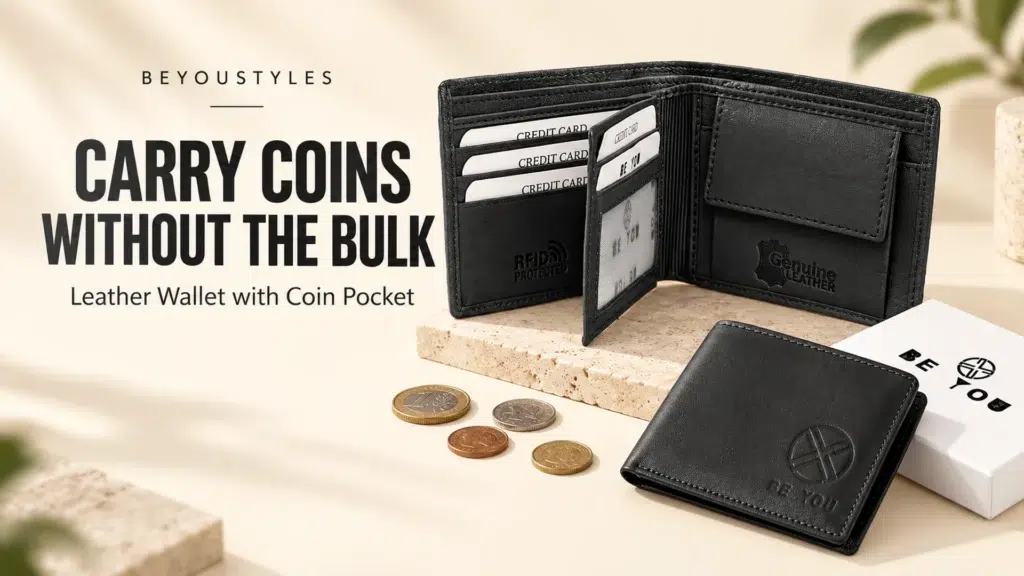
A leather wallet with a coin pocket gives your change a dedicated place, helping keep it separate from cards and banknotes. To control bulk, you also need to choose a suitable layout and carry only what you regularly use.
The Beyoustyles leather wallet with a snap-button coin pocket is one option for keeping coins, cards and notes organised. Here is how to make practical use of a coin compartment without overloading your everyday wallet.
Why Do Coins Make a Wallet Bulky?
Cards and banknotes generally lie in flat layers. Coins are rigid, and their edges overlap unevenly. Several coins stacked in one corner can create a noticeable raised section inside a folded wallet.
The coin compartment itself also contributes to thickness. Its leather panels, flap, fastening and stitching take up space even before you add any change. That extra storage can be useful, but it involves a trade-off between capacity and a thinner profile.
Other contents matter just as much. A few coins may be manageable in an organised wallet, while the same amount can feel excessive when every card slot and cash section is already full.
For more on how construction and everyday contents affect pocket carry, read our guide to wallet thickness and comfort.
1. Start by Removing Unnecessary Contents
Before deciding that your wallet needs replacing, empty it completely. Check which items you actually need during a normal day and which have simply collected over time.
- Keep regularly used payment cards and essential identification.
- Remove expired cards and membership cards you rarely use.
- Move receipts you need to retain into an appropriate filing place.
- Take out spare papers, duplicate cards and unnecessary folded notes.
- Separate useful change from coins you are unlikely to spend soon.
This gives you a realistic starting point. Removing clutter elsewhere leaves more room for useful change without increasing the wallet’s overall load.
2. Carry a Small Amount of Useful Change
The easiest way to reduce coin-pocket bulk is to avoid carrying every coin you receive. Think about the small payments you make regularly and keep change that serves those needs.
There is no fixed number of coins that suits every wallet. Coin sizes, denominations and compartment designs differ. A few large coins can occupy more room than several smaller ones.
Instead of following a universal coin count, check how your wallet behaves when loaded:
- Does the coin compartment close without pressure?
- Does the wallet fold naturally?
- Is there a pronounced lump on one side?
- Can you comfortably place it in your preferred pocket?
If the fastening struggles to meet or the wallet becomes awkward to fold, remove some change rather than forcing it closed.
3. Keep Coins in Their Dedicated Compartment
Loose coins should stay in the section designed to contain them. Putting them behind cards, inside an ID window or among banknotes makes the wallet harder to organise and can allow change to fall out when you open it.
A dedicated coin pocket separates rigid coins from flatter items. It also makes it easier to see how much change you are carrying and remove the excess.
Before fastening the compartment, gently spread the coins into a shallow layer where the design allows. This can reduce uneven stacking, although it does not remove the coins’ actual weight or thickness.
4. Balance Coin Storage with Card Capacity
A wallet’s compartments share the same folded space. Filling every card slot, both note sections and the coin pocket at once can make a compact design feel considerably thicker.
Available capacity is useful when you need it, but you do not have to fill every slot. Carry the cards needed for your routine and leave spare sections empty when possible.
Avoid forcing several cards into a slot unless it is designed for multiple cards. Overloading can make cards harder to access and place unnecessary pressure on the wallet’s construction.
Assess the complete load together. A wallet that holds your cards comfortably and your coins comfortably when tested separately may still feel overfilled when both are added at once.
5. Store Banknotes Neatly
Repeatedly folded notes create additional layers. If your wallet has full-length currency compartments, place suitable banknotes flat inside them rather than folding them into small bundles.
Keep receipts separate from your spending cash where possible. They can accumulate quickly, making it harder to find notes and increasing thickness around the fold.
When comparing wallets, check that the cash section suits the currency you normally carry. External dimensions alone do not tell you how comfortably your banknotes will fit.
6. Empty Surplus Coins Regularly
A coin pocket works best as short-term storage for useful change. Without a regular clear-out, even a well-organised wallet can gradually become overloaded.
Check your wallet when you get home or before leaving the next morning. Remove excess coins, clear unnecessary receipts and return occasional-use cards to their usual storage place.
This simple routine keeps the contents close to what you actually need. It also makes it easier to notice when a particular day requires a different carrying arrangement.
7. Test the Loaded Wallet in Your Pocket
An empty wallet can look compact on a product page or feel comfortable in your hand. The more useful test is how it feels with your everyday contents inside.
Place the loaded wallet in the pocket you normally use. Walk, sit down and check that you can remove it easily. Look for pulling around the pocket opening or pressure from a raised coin compartment.
Different trousers provide different amounts of room. If a loaded wallet feels awkward in fitted clothing, reduce the contents or carry it in a suitable bag rather than forcing it into a tight pocket.
What Should You Look for in a Leather Wallet with a Coin Pocket?
Choose your wallet around your normal carrying habits. Internal layout matters as much as appearance, particularly when you need space for cards, cash and change together.
| Feature | What to Check |
|---|---|
| Dedicated coin pocket | Coins should have their own compartment, separate from cards and notes. |
| Practical closure | The fastening should be easy to use and close without force when sensibly loaded. |
| Suitable card storage | Choose enough room for essential cards without relying on overfilled slots. |
| Appropriate cash section | Check that your usual banknotes fit neatly. |
| Closed dimensions | Compare measurements with your current wallet and preferred pocket. |
| Loaded profile | Consider the combined thickness of coins, cards, notes and internal panels. |
For broader buying considerations, explore our guide to leather wallets for men in the UK. Use your daily storage needs to narrow the options before choosing a finish or colour.
A Beyoustyles Option for Separate Coin Storage
The Beyoustyles Matte Dark Black Bifold with Coin Pocket is listed with full-grain genuine leather, a snap-button coin compartment, six-plus card slots, two full-length currency sections and a transparent ID window. Its listed closed dimensions are approximately 4.5 × 3.5 inches.
For someone who regularly carries small change, the separate coin compartment is the key practical feature. It provides a defined place for coins while keeping payment cards and notes in their own sections.
However, an organised layout cannot eliminate the thickness of its contents. Use the coin section for a modest amount of change and assess pocket comfort with your normal cards and cash included.
You can compare alternative layouts in the Beyoustyles Leather Wallets for Men collection. Look closely at interior photographs to understand how each design divides its storage.
When Is a Separate Coin Pouch More Practical?
A wallet with a coin pocket suits people who want to keep a little change alongside cards and notes. If you frequently receive large amounts of change, a separate pouch may be easier to manage.
A pouch moves the additional weight and thickness out of the wallet. It does mean carrying another accessory, so the right choice depends on whether you value keeping everything together or keeping your main wallet lighter.
- Occasional small-change use: A dedicated wallet compartment may be sufficient.
- Frequent coin-heavy transactions: Consider a separate coin pouch.
- Very limited pocket space: Reduce the overall load and assess whether coins need to stay in the wallet.
Common Coin-Storage Mistakes to Avoid
- Keeping every coin indefinitely: Remove surplus change before it accumulates.
- Forcing the closure: A struggling fastening is a reason to reduce the contents.
- Adding keys or other rigid objects: Irregular items create extra pressure and make the compartment harder to organise.
- Expecting leather to stretch into extra capacity: Use the wallet within its intended layout.
- Checking only the empty wallet: Judge comfort with your everyday contents inside.
- Ignoring clutter elsewhere: Excess cards and receipts contribute to bulk alongside coins.
Frequently Asked Questions
Does a coin pocket make a leather wallet bulky?
A coin pocket adds some material, and the coins add thickness and weight. Whether that feels bulky depends on the wallet’s layout, your other contents and the pocket you use. Carrying only useful change helps control the loaded profile.
How many coins should I carry in my wallet?
There is no universal number. Keep enough for your usual needs while ensuring the compartment closes easily and the wallet folds naturally. Remove coins if the loaded wallet becomes uncomfortable.
Can I put coins in a card slot?
A dedicated coin compartment is a better choice. Card slots are designed for flat items and generally do not contain loose change securely.
Will a leather wallet become thinner after breaking in?
Leather may soften with handling, but cards and coins retain their thickness. Do not rely on a break-in period to make an overloaded wallet comfortable.
Is a coin-pocket wallet suitable for everyday use?
It can be practical if you regularly need small change and want to keep it with your other essentials. Choose a layout that suits your cards and cash, then keep the coin compartment sensibly loaded.
Should I choose a wallet with a coin pocket or a separate pouch?
Choose a wallet compartment for modest amounts of everyday change. Consider a separate pouch if you often carry more coins than your wallet can comfortably accommodate.
Choose Practical Storage and Keep the Contents Manageable
Carrying coins comfortably starts with a dedicated compartment and a realistic limit on what you keep inside. Remove surplus change regularly, organise cards and notes, and check the complete wallet in your usual pocket.
If you want separate sections for everyday essentials, view the Beyoustyles leather bifold wallet with coin pocket and compare its layout with what you actually carry.