
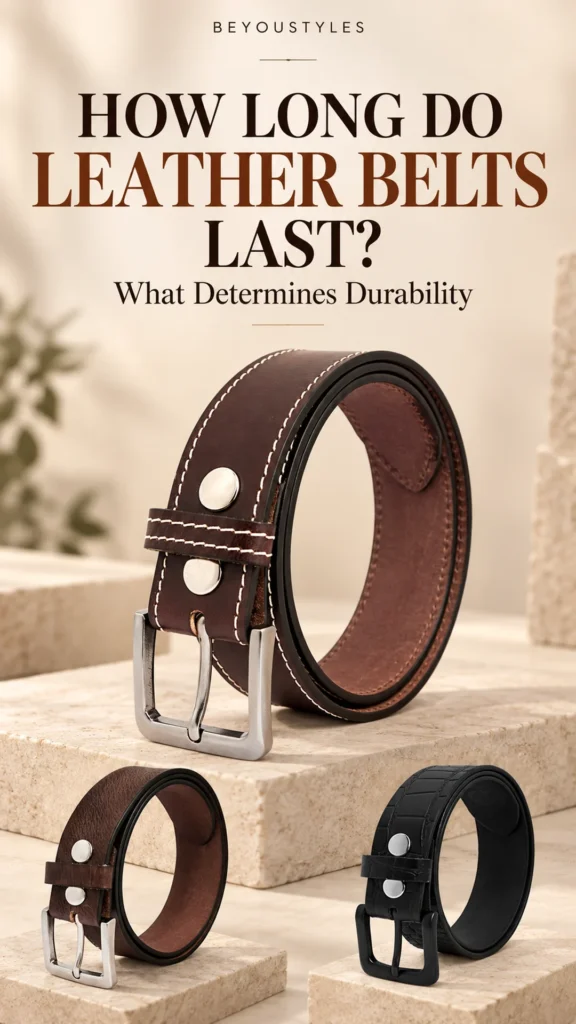
If you are choosing a belt for regular use, start with details you can assess. The Beyoustyles Stitched Texture Genuine Buff Grain Leather Belt is the featured example in this guide. Its listed leather construction, stitching and buckle provide practical buying checks without relying on a promised number of years.
Is There a Fixed Lifespan for a Leather Belt?
No. A calendar estimate cannot tell you how a particular belt will perform. The same number of years may represent a few dozen wears for one person and hundreds for another.
Instead of treating a suggested lifespan as a guarantee, look at the belt’s condition and how it functions. Does it fasten securely? Is the strap sound around the adjustment holes? Is the buckle attachment intact? These questions are more useful than replacing a belt simply because it has reached a certain age.
Wear-test results and written warranty terms can offer additional evidence when a seller provides them. An attractive finish, a leather label or a premium price alone does not establish a tested service life.
Six Things That Determine Leather Belt Durability
1. The Strap’s Material and Construction
Read the material description and ask how the strap is made. A leather belt may use different layers, finishes and assembly methods. The words in a product name do not explain all those details.
Look at photographs of the edges and underside, and ask for clarification if the construction is important to your purchase. Terms such as “buff grain” should be considered alongside the seller’s specific description rather than used to infer an exact lifespan.
2. The Buckle and Its Attachment
The leather is only part of a working belt. The pin, frame and connection to the strap also experience repeated movement. Inspect whether the pin sits correctly and whether the attachment looks secure.
A loose buckle connection can make an otherwise usable strap unreliable. If hardware starts moving unexpectedly, arrange an assessment before continuing to depend on it. Do not assume a buckle is replaceable unless the construction allows it.
3. The Way the Belt Fits
A belt should fasten comfortably without excessive pulling. If you repeatedly strain to reach a hole, review both the size and the fit of the trousers you are wearing. Using the belt to compensate for poorly fitting trousers can place unnecessary stress on the strap.
Before buying, check how the seller measures belt length. A labelled size may refer to a different measurement from the full end-to-end strap length. Compare the stated method with a belt you already wear comfortably.
4. How Often You Wear It
Daily wear means repeated bending at the buckle and use of the same adjustment area. Occasional use involves fewer fastening cycles, although storage conditions still matter.
If you already own another suitable belt, alternating them spreads wear between the two. This does not establish a fixed increase in lifespan, and you do not need to buy an extra belt solely to follow a rotation rule.
5. Moisture, Heat and Working Conditions
Consider where the belt will be worn. Regular exposure to moisture, abrasive surfaces or strong heat is different from ordinary indoor use. Choose a belt suited to the job and follow the maker’s care guidance for its particular finish.
If the belt becomes wet, avoid trying to speed drying with a heater or hair dryer. Let it dry naturally in a ventilated place and inspect it before the next wear.
6. Maintenance and Storage
Keep the belt free from loose dirt and avoid sharp folds during storage. Follow the seller’s instructions before using cleaners or conditioners, since products can affect different finishes differently.
For a fuller routine, read our guide to caring for a genuine leather belt. Maintenance should suit the leather’s condition and finish rather than follow an automatic treatment schedule.
Normal Ageing or Damage: What Should You Look For?
A change in appearance is not always a reason to discard a leather belt. Assess whether the change is cosmetic or whether it affects the strap’s ability to fasten securely.
| What you notice | What to check next |
|---|---|
| Light creasing at the buckle bend | Check whether the surface remains intact and the belt still functions normally. |
| Small surface marks or colour variation | Compare with the original finish and inspect for deeper damage. |
| An adjustment hole becoming elongated | Review sizing, tightening habits and the leather around the hole. |
| A split or tear extending from a hole | Stop relying on that area and seek repair advice or replace the belt. |
| Loose buckle hardware | Have the attachment assessed rather than continuing to tighten it under load. |
| Separating layers or substantial edge damage | Ask whether a sound repair is possible for that construction. |
Do not keep using a damaged hole simply because the rest of the belt still looks presentable. Our article on how belt holes wear over time explains this area in more detail.
Product Focus: Stitched Texture Genuine Buff Grain Leather Belt
The Beyoustyles Stitched Texture belt is listed in deep brown with contrast stitching and a brushed metal pin buckle. Its published dimensions are approximately 1.5 inches wide and 3.5 mm thick. The listing also describes single-piece full-grain leather construction.
These are useful specifications to review when comparing everyday belts. Check the width against your trouser loops, consider whether the finish suits your wardrobe, and confirm the measurement method before selecting a length.
- Material: listed as genuine buff grain leather.
- Appearance: deep brown with contrast stitching.
- Fastening: brushed metal pin buckle with adjustment holes.
- Intended styling: casual, smart-casual and business-casual outfits.
Those details help you assess suitability; they do not demonstrate that this belt will last a particular number of years. Check current product information and any written guarantee terms before ordering.
Can You Repair a Leather Belt Instead of Replacing It?
Sometimes. Repair depends on what has failed, how the belt is assembled and the condition of the surrounding leather. A repairer may be able to address certain hardware or stitching problems, while a deeply torn strap may not be worth restoring.
Do not add holes close to a tear or assume conditioner can restore damaged structure. Ask a leather repair professional to assess the belt when the problem affects fastening or the buckle connection.
A Better Way to Judge Long-Term Value
Choose a belt you can wear comfortably with your usual trousers and shoes. A suitable width, useful colour and dependable fastening matter more than a lifespan claim that has no supporting evidence.
Review the Stitched Texture Buff Grain Leather Belt’s sizes and construction details if you want a brown everyday option. To compare other finishes and buckle styles, browse the genuine leather belts for men collection.
Frequently Asked Questions
How long do leather belts last with daily wear?
There is no fixed lifespan. Material, assembly, fit, working conditions and care all matter. Inspect the strap, holes and buckle connection rather than relying on age alone.
Does a thicker leather belt always last longer?
No. Thickness is one specification. Leather quality, strap construction, hardware and fit also affect performance.
Are creases a sign that my leather belt needs replacing?
Not necessarily. Light creasing can occur where the strap bends. Deep splits, tearing near holes or insecure hardware need closer attention.
Can conditioner fix a cracked belt?
Do not treat conditioner as a structural repair. Follow the maker’s care guidance, and have deep cracking or torn areas assessed before continued use.
Is the featured Buff Grain belt guaranteed to last a set number of years?
No tested fixed lifespan is established by the product information reviewed for this article. Consult the seller’s current written warranty terms for any coverage.


