
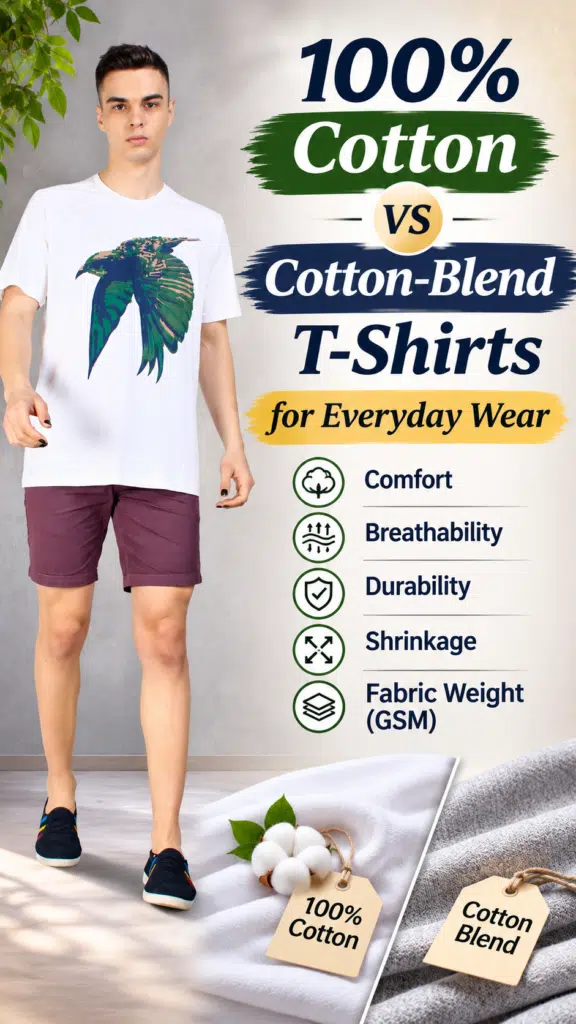
Choosing the right T-shirt starts with understanding the fabric. When comparing a 100% cotton vs cotton-blend T-shirt, the differences can affect comfort, breathability, drying time, stretch, care and how the garment feels throughout the day.
For men who wear T-shirts regularly, these details matter. A good everyday T-shirt should feel comfortable during long hours, suit the weather and work with your preferred outfits.
Both pure cotton and cotton-blend fabrics have advantages. The better choice depends on how you plan to wear your T-shirt.
In this guide, we compare cotton and cotton blends to help you choose the best fabric for everyday wear, casual styling and long-term wardrobe use.
What Is a 100% Cotton T-Shirt?
A 100% cotton T-shirt is made from fabric containing cotton fibres rather than a mixture of cotton and synthetic fibres.
Cotton is a natural plant-based fibre commonly used in casual clothing because of its comfortable feel, moisture absorption and versatility.
For everyday wear, 100% cotton T-shirts for men are popular because they offer:
- A natural fabric feel against the skin
- Good moisture absorption
- Comfortable everyday breathability
- Versatility for casual and layered outfits
- Options in different weights, fits and finishes
However, not every cotton T-shirt feels the same. Yarn quality, fabric construction, GSM, finishing and garment fit all influence comfort and performance.
What Is a Cotton-Blend T-Shirt?
A cotton-blend T-shirt combines cotton with one or more additional fibres. Common examples include cotton-polyester and cotton-elastane fabrics.
Different blends are designed for different purposes.
- Cotton-polyester: Often selected for easier care, faster drying and improved wrinkle resistance.
- Cotton-elastane: Usually selected when additional stretch and recovery are desirable.
- Tri-blend: Often combines cotton, polyester and rayon or viscose to create a particular drape and hand feel.
The performance of a cotton blend depends on its exact fibre percentages, knit structure and finishing. A 95% cotton and 5% elastane T-shirt will behave differently from a 50% cotton and 50% polyester T-shirt.
100% Cotton vs Cotton-Blend T-Shirts: Quick Comparison
| Feature | 100% Cotton | Cotton Blend |
|---|---|---|
| Fibre composition | Natural cotton fibre | Cotton mixed with other fibres |
| Breathability | Often comfortable for everyday wear | Varies with blend and construction |
| Moisture | Absorbs moisture readily | Some blends dry faster |
| Stretch | Depends on knit construction | Elastane blends can offer more stretch |
| Shrinkage | Can shrink depending on processing and care | Some blends offer better dimensional stability |
| Wrinkling | May wrinkle more readily | Polyester blends often resist wrinkles better |
| Fabric feel | Natural cotton hand feel | Varies by fibre mixture |
| Best use | Casual everyday clothing and layering | Easy-care, stretch or faster-drying needs |
1. Comfort: Which T-Shirt Feels Better?
Comfort is one of the most important considerations when buying premium men’s T-shirts.
Comfort of 100% Cotton
Pure cotton is often preferred by people who enjoy a natural fabric feel. Depending on the yarn, knit and finish, cotton can feel soft, smooth and comfortable against the skin.
A well-constructed cotton T-shirt can be suitable for everyday activities, relaxed weekends and casual office outfits.
Comfort of Cotton Blends
Cotton blends can also be comfortable. Polyester may change the fabric’s texture and drying behaviour, while elastane can provide additional stretch.
For someone who prefers a close-fitting T-shirt with more flexibility, a cotton-elastane blend may be appealing.
Verdict: Choose 100% cotton if you prefer a natural fabric feel. Consider a blend when stretch, drying speed or easier maintenance is more important.
2. Breathability: Cotton vs Cotton Blend in Warm Weather
Breathability matters when choosing T-shirts for men during warm weather or long days.
Many cotton T-shirts feel comfortable because their fabric structure allows air movement while the fibres absorb moisture.
However, cotton can retain absorbed moisture and take longer to dry after heavy sweating.
Some polyester-rich blends dry more quickly, although their breathability and comfort depend on fabric construction.
For everyday summer outfits, a well-made cotton T-shirt can be an excellent option. For activities involving significant perspiration, a purpose-designed moisture-management fabric may be more practical.
3. Shrinkage: Does Cotton Shrink More Than Cotton Blend?
One concern when buying cotton T-shirts online is whether the garment will shrink after washing.
Cotton garments can change dimensions when exposed to laundering, particularly when excessive heat is used.
Some cotton-polyester blends may offer improved dimensional stability, but the results depend on construction and finishing.
How to Reduce T-Shirt Shrinkage
- Follow the manufacturer’s care label.
- Use cool or moderate washing temperatures when recommended.
- Avoid unnecessary high-temperature tumble drying.
- Reshape the garment gently when appropriate.
- Check whether the T-shirt has been pre-shrunk.
Pre-shrinking helps reduce expected dimensional changes but does not guarantee that a garment will never shrink.
4. Durability: Which Fabric Lasts Longer?
Durability depends on more than whether a T-shirt is pure cotton or a blend.
Important factors include:
- Fibre and yarn quality
- Fabric weight and knitting density
- Stitching and seam construction
- Finishing processes
- Frequency of wear
- Washing and drying habits
Polyester-containing blends may provide improved resistance to certain types of wear, while a well-constructed cotton T-shirt can also deliver reliable everyday performance.
Neither fabric composition guarantees that a T-shirt will never pill, fade, stretch or lose shape.
5. Fabric Weight: Why GSM Matters
GSM stands for grams per square metre and describes fabric weight.
When comparing similar T-shirt constructions, GSM helps shoppers understand how substantial the fabric may feel.
For example, 180 GSM cotton fabric can offer a useful balance between fabric substance and everyday comfort.
However, GSM alone does not determine softness, durability, breathability or opacity.
Two T-shirts with identical GSM ratings can feel different because of their yarn, knit structure and finishing.
For a more detailed explanation, read our 180 GSM White Cotton T-Shirts for Men guide.
6. Is Bio-Washed Cotton Better for Everyday T-Shirts?
When comparing premium cotton T-shirts, you may encounter the term bio-washed cotton.
Bio-washing is a finishing process commonly associated with enzyme treatment. It is intended to reduce some protruding surface fibres and create a cleaner, smoother fabric surface.
Importantly, bio-washing does not change the fibre composition of a 100% cotton T-shirt.
A T-shirt can be 100% cotton and also bio-washed, pre-washed and pre-shrunk.
Bio-washing may contribute to a more refined hand feel, although the overall garment quality still depends on the fabric and construction.
Learn more in our Bio-Washed vs Regular Cotton T-Shirts comparison.
7. Which Fabric Is Better for Plain and Graphic T-Shirts?
Fabric selection matters for both plain T-shirts and graphic T-shirts.
Plain T-Shirts
A plain T-shirt places greater visual emphasis on the fabric surface, neckline, fit and overall silhouette.
For a classic everyday look, a well-finished 100% cotton round-neck T-shirt is a versatile choice.
Graphic T-Shirts
Graphic T-shirts can be made from cotton or blends. The most suitable fabric depends on the printing method, fabric surface, intended fit and care requirements.
Cotton is widely used for printed casual T-shirts, but it is important to check the individual garment rather than assume that every printing process works equally well on every fabric.
8. Why Consider Beyoustyles 100% Cotton T-Shirts?
Beyoustyles offers cotton T-shirts designed for everyday styling, including plain white options that can be worn alone or layered.
Two products worth comparing are:
Beyoustyles Plain White T-Shirt
The Beyoustyles Plain White T-Shirt features 100% cotton, 180 GSM single jersey fabric, a bio-washed finish, a classic round neckline and a regular fit.
Its simple design makes it suitable for pairing with jeans, chinos, cotton shorts or a casual jacket.
Beyoustyles True Classic Tees White T-Shirt
The Beyoustyles True Classic Tees White T-Shirt is another 100% cotton option featuring 180 GSM single jersey fabric, bio-washing and a regular unisex fit.
When comparing these products, review the photographs, individual size charts and current availability to decide which option best suits your needs.
Both illustrate why fabric composition, finishing and fit should be considered together when shopping for premium men’s T-shirts.
9. How to Choose the Right T-Shirt for Everyday Wear
Before purchasing a cotton or cotton-blend T-shirt, consider these practical questions:
- Where will you wear it? Choose fabric and construction suitable for casual outings, work, travel or exercise.
- What fabric feel do you prefer? Pure cotton offers a natural feel, while blends can provide different textures and stretch characteristics.
- How important is drying time? Cotton absorbs moisture, while certain synthetic blends can dry more quickly.
- What fit do you want? Compare chest, shoulder, sleeve and body-length measurements.
- How will you care for it? Check washing instructions, shrinkage treatments and drying recommendations.
- What does the fabric specification say? Review composition, GSM, finishing and construction.
If you are buying online, our How to Measure a T-Shirt Before Buying guide explains how to compare measurements with a T-shirt you already own.
10. Which Is Better: 100% Cotton or Cotton Blend?
There is no universal winner in the cotton vs cotton-blend T-shirt comparison.
Choose 100% cotton when:
- You prefer natural cotton fabric against your skin.
- You want a versatile everyday casual T-shirt.
- You value a classic plain or round-neck style.
- You prefer cotton for layering under jackets or hoodies.
Consider cotton blends when:
- You need additional stretch from elastane.
- You prefer certain easy-care fabric properties.
- You want a faster-drying polyester-containing fabric.
- You have a specific activity requiring different fabric performance.
For many everyday casual wardrobes, a well-made 100% cotton T-shirt remains a strong choice. The most important consideration is the quality and suitability of the complete garment.
Frequently Asked Questions
Is 100% cotton better than cotton blend for T-shirts?
100% cotton may be preferable if you enjoy natural fibres and a classic casual feel. Cotton blends can be better suited to specific needs such as stretch, quicker drying or wrinkle resistance. The best option depends on the garment and its intended use.
Are 100% cotton T-shirts good for everyday wear?
Yes. Well-made 100% cotton T-shirts are suitable for everyday outfits, casual activities and layering. Comfort depends on fabric weight, construction, fit and finishing.
Which is more breathable, cotton or cotton blend?
Breathability depends on fibre content, knit structure and fabric density. Many cotton fabrics are comfortable for casual wear, but a carefully engineered blend may also offer good airflow and moisture management.
Do cotton-blend T-shirts shrink?
They can. Some blends may be more dimensionally stable than comparable pure cotton fabrics, but shrinkage depends on the fibre mixture, construction, processing and laundry conditions.
Is cotton-polyester better than 100% cotton?
Cotton-polyester may offer faster drying and improved wrinkle resistance. Pure cotton may be preferred for its natural fabric feel. Neither is automatically superior for every wearer.
Is 180 GSM good for a cotton T-shirt?
180 GSM is a useful fabric weight for many everyday T-shirts. It can offer noticeable substance without necessarily feeling excessively heavy. Fit, knitting and finishing also matter.
Are cotton T-shirts better for sensitive skin?
Some people prefer the feel of cotton, but comfort varies by individual. Dyes, finishes, seams, detergent residues and fabric texture can also affect skin comfort. Cotton is not guaranteed to prevent irritation.
Can 100% cotton T-shirts be used for graphic prints?
Yes. Cotton is commonly used for graphic T-shirts. Print quality and durability depend on the printing process, ink, fabric preparation and care.
Final Verdict: Choose Fabric Based on Your Everyday Needs
The choice between 100% cotton and cotton-blend T-shirts comes down to comfort preferences, garment construction, intended use and care requirements.
Pure cotton is an excellent option for shoppers who appreciate a natural fabric feel and versatile casual styling. Cotton blends provide useful alternatives when stretch, drying speed or particular easy-care characteristics matter more.
Rather than judging quality by fibre content alone, compare the GSM, fabric finishing, neckline, stitching and fit.
If you are looking for classic cotton T-shirts for men, explore the Beyoustyles Men’s T-Shirts collection to discover everyday cotton styles and compare the available options.


