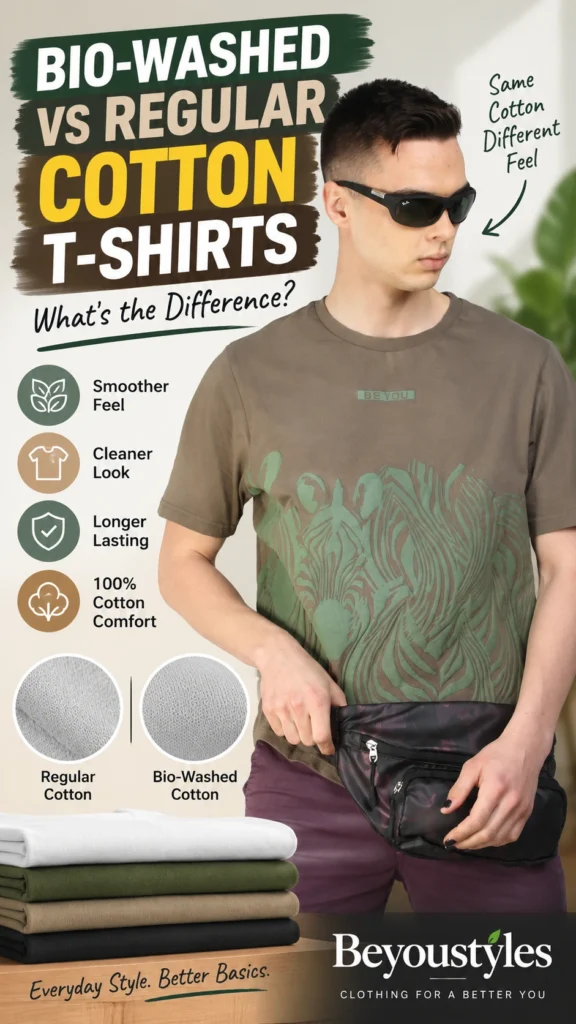
One reason for this difference can be the finishing process used on the cotton fabric.
This is where bio-washed cotton comes in.
If you are comparing bio-washed vs regular cotton, it is important to understand that bio-washing does not turn cotton into a different fibre. Instead, it is a finishing process used to improve the surface characteristics and feel of cotton fabric.
In this guide, we will explain what bio-washed cotton means, how it differs from regular cotton, and what you should consider when choosing a cotton T-shirt for everyday wear.
For example, the
Beyoustyles Plain White T-Shirt
combines 100% cotton with a bio-washed finish, 180 GSM fabric, pre-washed and pre-shrunk construction, a round neck and regular fit.
What Is a Bio-Washed Cotton T-Shirt?
A bio-washed cotton T-shirt is a cotton garment that has undergone an additional textile-finishing process designed to create a cleaner and smoother fabric surface.
Cotton fibres can have tiny protruding fibres on their surface. These can contribute to a fuzzier appearance and may influence how smooth the fabric feels.
Bio-washing is commonly associated with the use of enzymes during textile processing to help remove some of these protruding surface fibres.
The result can be a cotton fabric with a cleaner surface and a more refined hand feel.
What Is Regular Cotton?
Regular cotton refers broadly to cotton fabric that has not necessarily received the same bio-washing or enzyme-finishing treatment.
This does not automatically mean regular cotton is poor quality.
Cotton T-shirt quality depends on several factors, including:
- Quality of the cotton fibre
- Yarn construction
- Fabric knitting
- Fabric weight
- Finishing processes
- Dyeing
- Stitching and construction
- Pre-washing and shrinkage control
Bio-washing should therefore be considered one part of the overall T-shirt construction rather than a single measure of quality.
Bio-Washed vs Regular Cotton: Quick Comparison
| Feature | Bio-Washed Cotton | Regular Cotton |
|---|---|---|
| Material | Cotton | Cotton |
| Additional Bio-Wash Finish | Yes | Not necessarily |
| Surface | Generally cleaner and smoother | Depends on fabric and finishing |
| Hand Feel | Can feel softer and more refined | Can range from soft to comparatively firm |
| Surface Fuzz | Bio-washing is intended to reduce protruding fibres | May retain more surface fibres depending on construction |
| Overall Quality | Depends on fabric and garment construction | Depends on fabric and garment construction |
How Does Bio-Washing Work?
The basic purpose of bio-washing is to improve the surface of cotton fabric.
During textile processing, enzymes can be used under controlled conditions to act on small fibres protruding from the cotton surface.
After the treatment and subsequent processing, the fabric can have a smoother and cleaner appearance.
This process is also sometimes discussed in the textile industry in relation to terms such as bio-polishing or enzyme treatment.
The exact process can vary between textile manufacturers, so the term “bio-washed” should not be interpreted as a guarantee that every garment will have exactly the same texture.
1. Bio-Washed Cotton Can Have a Smoother Surface
One of the most noticeable differences between bio-washed and untreated cotton can be the fabric surface.
Tiny fibres projecting from cotton yarn can create a slightly fuzzy surface.
Bio-washing is intended to reduce some of these protruding fibres, helping create a cleaner surface.
This can be particularly useful for a plain T-shirt because there are no large graphics or patterns hiding the fabric itself.
On a simple white T-shirt, fabric texture, fit and finishing become important parts of the overall appearance.
2. Bio-Washed Cotton Can Feel More Refined
When people talk about a “premium” cotton T-shirt, they often think first about softness.
However, premium feel is not determined by softness alone.
The surface finish, fabric weight, fit, stitching and garment construction all contribute to the experience.
Bio-washing can contribute to a smoother hand feel by refining the surface of the cotton fabric.
3. Bio-Washing and Pilling Are Related — But Don’t Overstate It
Pilling occurs when fibres become entangled and form small balls on a fabric surface.
Because bio-washing can remove some protruding surface fibres, it may help create a cleaner surface.
However, it would be misleading to claim that a bio-washed T-shirt can never pill.
Pilling and surface wear can also depend on:
- Yarn quality
- Fabric construction
- Friction
- Washing method
- Drying method
- Frequency of use
- How the garment is cared for
Bio-washing should therefore be viewed as one fabric-finishing advantage rather than a permanent guarantee against wear.
4. Is Bio-Washed Cotton Still 100% Cotton?
Yes, a garment can be both 100% cotton and bio-washed.
“100% cotton” describes the fibre composition of the garment.
“Bio-washed” describes a finishing process applied to the cotton fabric.
These terms therefore describe two different things.
A T-shirt can be:
- 100% cotton
- Bio-washed
- Pre-washed
- Pre-shrunk
at the same time.
5. Bio-Washed Is Not the Same as Pre-Washed
This distinction is important when shopping for cotton T-shirts.
Bio-washing relates primarily to fabric-surface finishing.
Pre-washing means the garment or fabric has undergone washing before reaching the customer.
The two processes can serve different purposes.
A T-shirt can therefore be both bio-washed and pre-washed.
6. Bio-Washed Is Also Not the Same as Pre-Shrunk
Another common source of confusion is the difference between bio-washed and pre-shrunk cotton.
Bio-washing focuses on the surface characteristics of the cotton.
Pre-shrinking is intended to reduce the amount of dimensional change that may occur during later washing.
They are separate characteristics.
This is why looking at the complete product specification gives you more useful information than looking for one marketing term.
Why 180 GSM Matters in a Cotton T-Shirt
Bio-washing tells you about finishing, but it does not tell you how heavy the fabric is.
For that, you need to look at GSM.
GSM means grams per square metre and is a measurement of fabric weight.
A 180 GSM cotton T-shirt sits in a useful everyday range, offering more substance than many lightweight tees without automatically becoming excessively heavy.
However, GSM should not be treated as a standalone quality score. Two fabrics with the same GSM can still feel different because of yarn, knitting and finishing.
If you want to understand this measurement in more detail, read our guide to
180 GSM T-shirts and how fabric weight affects everyday wear.
Why Bio-Wash Works Well for a Plain White T-Shirt
A plain white T-shirt is intentionally simple.
That simplicity makes details more noticeable.
There is nowhere for poor construction, rough fabric or an awkward fit to hide.
A good plain white tee therefore benefits from a combination of:
- Quality cotton
- Appropriate fabric weight
- Clean surface finishing
- Comfortable neckline
- Reliable stitching
- Proper fit
- Pre-washing and shrinkage consideration
The
Plain White T-Shirt from Beyoustyles
is designed around this combination with 100% cotton, 180 GSM fabric, bio-washing, pre-washing, pre-shrinking, a round neck and regular fit.
Bio-Washed vs Regular Cotton: Which Feels Softer?
A bio-washed cotton fabric can feel smoother because the finishing process is intended to reduce unwanted surface fibres.
But you should not assume that every bio-washed cotton T-shirt will automatically be softer than every regular cotton T-shirt.
Softness can also be influenced by:
- Cotton quality
- Yarn
- Knitting structure
- Fabric weight
- Dyeing
- Other finishing treatments
- Garment age
- Laundry care
A better comparison is the complete garment rather than a single specification.
Does Bio-Washed Cotton Shrink?
Bio-washing should not be confused with shrinkage control.
Cotton can change dimensions when exposed to washing, moisture and heat.
If shrinkage is an important consideration, look specifically for information about whether the T-shirt is pre-shrunk.
Even with a pre-shrunk garment, you should always follow the manufacturer’s care instructions because inappropriate washing or excessive heat can still affect cotton clothing.
Does Bio-Washing Make a T-Shirt More Durable?
It is better not to describe bio-washing as a simple durability treatment.
Garment durability depends on the whole product:
- Fibre and yarn quality
- Fabric construction
- Stitching
- Seams
- Finishing
- Washing
- Drying
- Frequency of wear
Bio-washing can improve surface characteristics, but it should not be used as the only predictor of how long a T-shirt will last.
Bio-Washed Cotton vs Regular Cotton for Everyday Wear
For everyday clothing, comfort and versatility matter.
A cotton T-shirt may be worn on its own in warm weather or layered underneath a sweatshirt, hoodie or jacket when temperatures fall.
A bio-washed finish can be attractive for everyday T-shirts because it contributes to a cleaner, smoother fabric surface.
But the best everyday T-shirt should combine that finishing with suitable GSM, comfortable construction and the right fit for the wearer.
What Should You Look for When Buying a Cotton T-Shirt?
Instead of relying on one phrase such as “premium” or “bio-washed,” check the complete specification.
Consider:
1. Fibre Composition
Check whether the garment is 100% cotton or a blend.
2. GSM
GSM gives you an indication of fabric weight.
3. Fabric Finish
Look for information such as bio-washing when surface feel and finishing matter to you.
4. Pre-Shrinking
If listed, pre-shrinking tells you that shrinkage has been considered during production.
5. Fit
Regular, slim and oversized fits can produce very different results even when the fabric is identical.
6. Neckline
A classic round-neck T-shirt is versatile for casual wear and layering.
7. Construction
Stitching, seams and finishing also influence how a garment performs over repeated wear.
Who Should Consider a Bio-Washed Cotton T-Shirt?
A bio-washed cotton T-shirt may appeal to someone who:
- Prefers cotton clothing
- Likes a smoother fabric surface
- Wants a refined everyday basic
- Frequently wears plain T-shirts
- Uses T-shirts for layering
- Values fabric finishing as well as composition
It is particularly relevant when you want a simple T-shirt where fabric quality and finish are major parts of the overall look.
Plain White vs Graphic T-Shirts
Graphic T-shirts naturally draw attention to the printed artwork.
A plain white T-shirt works differently.
The visual appeal comes primarily from:
- Fabric
- Fit
- Neckline
- Construction
- Clean colour
- Overall silhouette
This is one reason finishing processes such as bio-washing can be especially relevant to premium plain basics.
How to Care for a Bio-Washed Cotton T-Shirt
A fabric finish does not eliminate the need for proper garment care.
Always follow the specific care label attached to your T-shirt.
As general cotton-care principles, consider:
- Following the recommended wash temperature
- Using an appropriate amount of detergent
- Avoiding unnecessarily aggressive washing
- Separating garments when colour transfer is a concern
- Avoiding excessive drying heat
- Following ironing instructions
Correct care helps protect the fabric, dimensions, colour and overall appearance of the garment.
Bio-Washed vs Regular Cotton: Which Should You Choose?
There is no reason to assume that all regular cotton T-shirts are inferior.
A well-made regular cotton tee can still be an excellent garment.
However, when two otherwise similar cotton T-shirts are being compared, bio-washing is a useful additional finishing feature to consider if you value a smoother and cleaner surface.
For a premium everyday basic, look for a combination rather than one specification:
- 100% cotton
- Suitable GSM
- Good fabric finishing
- Pre-shrinking where applicable
- Comfortable fit
- Reliable garment construction
Explore Men’s Cotton T-Shirts at Beyoustyles
If you are looking for cotton basics, explore the
Beyoustyles Men’s T-Shirts collection.
The collection includes plain and other cotton T-shirt options designed for versatile everyday styling.
Frequently Asked Questions
What does bio-washed mean in a T-shirt?
Bio-washed generally refers to a textile-finishing process in which enzymes are used to help remove protruding fibres from the surface of cotton fabric, producing a cleaner and potentially smoother finish.
Is bio-washed cotton better than regular cotton?
Bio-washing can provide a smoother, cleaner surface, but it does not automatically make every bio-washed T-shirt better than every regular cotton T-shirt. Overall quality also depends on cotton, yarn, knitting, GSM, stitching, fit and other finishing processes.
Is bio-washed cotton still pure cotton?
Yes. A T-shirt can be 100% cotton and bio-washed because cotton describes the fibre composition while bio-washing describes a finishing process.
Is bio-washed the same as pre-shrunk?
No. Bio-washing primarily relates to fabric-surface finishing, whereas pre-shrinking is intended to reduce subsequent dimensional change.
Is bio-washed the same as pre-washed?
No. They describe different processing stages or purposes. A cotton T-shirt can be bio-washed, pre-washed and pre-shrunk.
Does a bio-washed T-shirt never pill?
No. Bio-washing may help reduce protruding surface fibres, but pilling also depends on yarn, fabric construction, friction, washing and everyday wear.
Is 180 GSM good for a cotton T-shirt?
180 GSM provides a useful balance for many everyday cotton T-shirts, offering noticeable fabric substance without necessarily becoming excessively heavy. GSM alone, however, does not determine quality.
Are bio-washed T-shirts good for everyday wear?
They can be. A smoother cotton surface can make bio-washed T-shirts attractive for everyday basics, although fit, fabric weight, construction and personal preference should also be considered.
Final Thoughts
The biggest difference in the bio-washed vs regular cotton comparison is not the underlying cotton fibre—it is the additional finishing applied to the fabric.
Bio-washing is designed to refine the cotton surface by reducing unwanted protruding fibres. This can contribute to a smoother, cleaner and more finished feel.
But a genuinely good T-shirt is the result of several characteristics working together.
Fabric composition, GSM, finishing, pre-shrinking, stitching and fit should all be considered.
For a plain everyday basic, a combination such as 100% cotton + 180 GSM + bio-washed + pre-washed + pre-shrunk provides a strong specification to look for.