
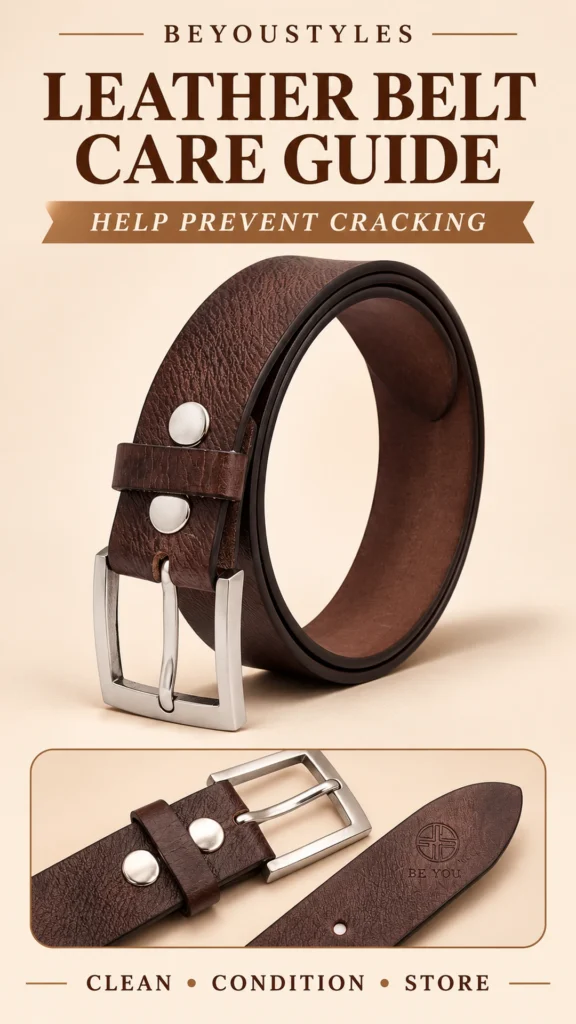
If you want to learn how to care for a leather belt, start with the finish and the maker’s instructions. The featured Beyoustyles dark brown genuine leather belt is listed as the Premium Leather Belt for Men – Classic Brown. It has a dark-brown finish, a polished silver frame buckle and multiple adjustment holes. This guide explains a practical care routine for a smooth finished leather belt, subject to its specific care advice.
Quick Answer: How Do You Care for a Leather Belt?
Remove surface dust with a clean, soft cloth, avoid soaking the leather, and let accidental dampness dry naturally away from heat. Store the belt straight or loosely rolled without sharp folds. Use only cleaning or conditioning products suitable for its finish, test them discreetly first, and avoid fastening the belt under excessive tension.
These habits can reduce avoidable wear, but no routine guarantees a crack-free belt. Leather condition, surface coatings, construction, use and storage all affect how a belt ages.
Understand Creasing, Cracking and Peeling Before Treating Them
Not every mark needs a treatment. A belt naturally flexes around the waist and near the buckle, so some creasing can develop through normal wear. Look at the surface in good light without folding the strap backwards to expose it.
| What you notice | What to do next |
|---|---|
| Gentle creases without open splits | Review fit and storage; avoid repeatedly bending the same spot sharply. |
| Dry feel or unusual stiffness | Check the maker’s advice before choosing a compatible conditioner. |
| Flaking or peeling surface | Ask the seller or a leather specialist to identify the finish and damage before applying products. |
| Open splits near holes or the buckle | Stop forcing the damaged area and have the belt assessed for safe use or replacement. |
Conditioner is not a repair for torn leather, missing surface coating or a broken buckle. Applying more product to an unidentified problem can change the appearance without addressing its cause.
Step 1: Remove Dust Before It Builds Up
Take the belt out of your trousers and lay it on a clean surface. Wipe the strap gently with a soft, dry cloth, paying attention to areas around the keeper and buckle where dust can collect. Use a clean section of cloth rather than rubbing grit along the leather.
If a mark remains, check the care instructions before using a barely damp cloth or a cleaner approved for that finish. Avoid saturating the strap, scrubbing aggressively or applying household detergent directly. A suede or nubuck surface needs a different approach from smooth finished leather.
For a stain you cannot identify, ask for advice rather than trying several cleaners in succession. Keep alcohol, bleach and general-purpose surface sprays away from the belt.
Step 2: Let a Damp Belt Dry Slowly
If rain or a spill wets the belt, blot gently with an absorbent cloth. Do not twist or wring the strap. Let it dry at room temperature in a ventilated place, supported without a sharp bend.
Keep it away from radiators, hair dryers, direct sun and hot car interiors. Do not speed up drying by pressing it with an iron. Wait until the belt is dry before storing it in a drawer or applying any treatment permitted by its care instructions.
After a humid day, remove it from your trousers and let it air before putting it away. If you own another suitable belt, alternating between them gives each strap a break from repeated fastening and allows time to dry after wear.
Step 3: Condition Only When the Finish Allows It
Before buying a conditioner, establish whether the belt’s maker recommends one and which type suits the finish. A product suitable for one leather item may darken, stain or leave residue on another. “Natural” or “all-purpose” on a label is not enough to establish compatibility.
- Remove loose dust and make sure the belt is dry.
- Read the conditioner’s directions and check its intended leather types.
- Test a tiny amount in an inconspicuous place with the same finish as the area you plan to treat.
- Allow the test area to dry fully, then check for darkening, tackiness or colour transfer.
- If suitable, apply sparingly and follow the product’s directions for absorption and removal of excess.
Do not use a fixed calendar as the only reason to condition. Climate, wear and finish affect what the belt needs. Repeated heavy applications can leave buildup. If the belt remains supple and the maker does not recommend additional treatment, more conditioner may not be useful.
Avoid improvised treatments such as cooking oil, petroleum jelly or hand cream unless the belt manufacturer specifically approves them. They are not substitutes for finish-compatible care.
Step 4: Protect the Holes and Buckle Bend
Undo the buckle fully before removing the belt. Guide the strap through the frame rather than sharply pulling it back against the prong. Do not force the pin into an undersized or damaged hole.
A belt should hold your trousers comfortably without needing to be pulled extremely tight. If the hole you use is becoming elongated, or your only comfortable setting is at the end of the adjustment range, review the size instead of relying on the leather to stretch.
Keep the buckle clean with a soft cloth. Use metal-care products only if approved for the actual buckle finish and keep them off the leather. A silver-coloured buckle should not automatically be treated as solid silver.
For more context on fastening mechanisms, read our guide to belt buckle types. Understanding the fastening helps you handle the strap and hardware appropriately.
Step 5: Store It Without Sharp Folds
Use a suitable belt hanger that supports the belt without forcing the strap over a narrow edge. If you prefer drawer storage, make a loose roll with a generous curve. Do not fold the belt in half, fasten it into a tiny coil or crush it beneath other accessories.
Choose a dry, ventilated storage area away from direct sunlight. Pack it loosely when travelling and avoid sealing a damp belt inside a bag. The objective is to prevent concentrated bends while keeping moisture from becoming trapped.
A Practical Routine for Your Deep Brown Leather Belt
Keep the routine simple enough to follow after an ordinary workday. Remove the belt, check it for dampness or dirt, wipe away loose dust and store it without a tight bend once dry. Periodically inspect the holes, keeper, edges and buckle attachment for changes.
When choosing a replacement or a second belt for rotation, review the Classic Brown leather belt with polished silver buckle for current photographs, sizing and specifications. Ask for finish-specific care guidance before applying a new product.
You can compare other colours and designs in the genuine leather belts for men collection. Choose a size and width that work comfortably with your trousers rather than forcing a strap through narrow loops.
For a broader overview of cleaning and storage habits, see our existing leather belt care tips. Follow the instructions supplied with your particular belt whenever advice differs.
Mistakes That Can Increase Avoidable Wear
- Soaking the belt or putting it through a washing machine.
- Drying damp leather with strong heat.
- Applying an untested conditioner to the whole strap.
- Folding the belt sharply in the same place every day.
- Overtightening or forcing the prong through a damaged hole.
- Assuming conditioner can restore strength to split leather.
Frequently Asked Questions
How do I stop a leather belt from cracking?
Reduce exposure to excess moisture and heat, avoid sharp folds and excessive tension, and use finish-compatible care when recommended. These steps reduce avoidable damage but cannot guarantee that cracking will never occur.
How often should I condition a leather belt?
Follow the maker’s guidance and assess the belt’s condition. There is no single interval suitable for every leather finish, climate or wearing pattern. Test any approved product before broader use.
Can I wash a genuine leather belt?
Do not machine-wash or soak it. Begin with gentle dry wiping and use further cleaning only as allowed by the belt’s care instructions.
Can cracked leather be repaired with conditioner?
Conditioner cannot join torn fibres or replace a damaged coating. Ask a leather specialist about visible splits, peeling or weakened fastening areas before continuing to wear or treat the belt.
Should I hang or roll my belt?
Either can work if the belt is dry and supported without sharp bends. Use a suitable hanger or a loose roll rather than folding the strap tightly.


