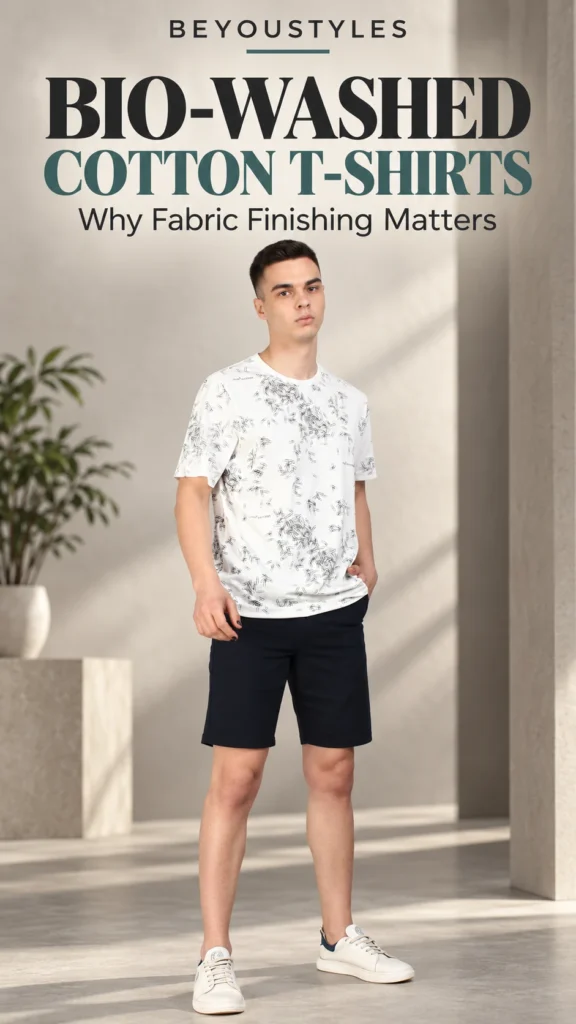
A plain cotton tee can look simple, yet several production choices influence how it feels when you wear it. The cotton fibre, yarn, knitting, fabric weight and finishing all contribute to the final garment. That is why a bio-washed cotton T-shirt deserves a closer look beyond its colour and size.
Bio-wash is commonly an enzyme-based finish used to reduce tiny fibres protruding from the cotton surface. It can produce a smoother feel and a cleaner appearance. For an everyday white tee, that finish is useful to consider alongside fit, construction and washing instructions.
This guide explains what bio-washing can do, what it does not promise, and how to evaluate it when choosing cotton T-shirts for men.
What Is a Bio-Washed Cotton T-Shirt?
A bio-washed cotton T-shirt is made using cotton fabric that has received a finishing treatment commonly associated with bio-polishing. In this process, cellulase enzymes act on small protruding cotton microfibres under controlled manufacturing conditions.
Reducing these surface fibres helps refine the fabric’s appearance and feel. Cotton remains cotton after the treatment: “100% cotton” describes fibre composition, while “bio-washed” describes a finish. These terms provide different information about the same garment.
The exact process can vary by manufacturer. The words bio-washed alone do not reveal the treatment recipe, production conditions or measured performance of a particular T-shirt.
Why Fabric Finishing Matters for an Everyday Tee
It Can Make the Surface Feel Smoother
A T-shirt often sits directly against your skin, so surface texture matters. Removing some protruding fibres can improve the hand feel—the way the fabric feels when touched. This can make a cotton tee more pleasant to wear under an open shirt, jacket or hoodie.
However, bio-washing is only one contributor to comfort. Yarn quality, knitting and other finishing stages can make two bio-washed T-shirts feel different. Evaluate the complete garment rather than treating one label as a softness score.
It Can Give Cotton a Cleaner Appearance
Surface fuzz can make knitted cotton look less uniform. Bio-polishing can reduce that fuzz, contributing to a neater appearance. This is particularly relevant to plain T-shirts, where the fabric itself is the main visual feature.
A smoother finish does not establish how opaque a white tee will be. Opacity also depends on knit structure, thickness, fit and lighting. Check product photos and consider what you plan to wear underneath.
It Can Improve Resistance to Surface Pilling
Properly controlled bio-polishing can improve pilling performance by removing loose fibres that might otherwise form small surface balls. This is a potential process benefit, not a promise that every treated tee will remain pill-free. Wear, friction and laundering still affect its surface.
Bio-Washed Cotton vs Cotton Without This Finish
The difference is an additional finishing stage, rather than a new kind of cotton. A well-made untreated cotton tee can still be comfortable; a bio-wash label does not automatically make another garment superior.
| Detail | Cotton Without a Stated Bio-Wash | Bio-Washed Cotton |
|---|---|---|
| Composition | Can be 100% cotton or a blend. | Can also be 100% cotton or a blend; check the label. |
| Surface treatment | No bio-wash is specified; other finishes may be used. | A bio-wash finishing treatment is specified. |
| Surface feel | Depends on the fabric and manufacturing process. | Can feel smoother after surface fibres are reduced. |
| Pilling | Depends on fibre, yarn, construction and use. | Proper treatment can improve performance, but does not eliminate all pilling. |
| Overall quality | Requires assessment of the whole garment. | Still requires assessment of the whole garment. |
Bio-Wash Is Different From Pre-Washing and Pre-Shrinking
These three descriptions often appear together, but they answer different questions.
- Bio-washed: Describes a finish commonly used to reduce surface fuzz and refine fabric feel.
- Pre-washed: Means the fabric or garment has been washed during production.
- Pre-shrunk: Describes processing intended to reduce dimensional change during later laundering.
Bio-wash does not make cotton shrink-proof. Pre-shrinking also does not guarantee zero further shrinkage, particularly if the garment is exposed to unsuitable washing or drying temperatures. Follow the care label even when all three features are listed.
A Product Example: Beyoustyles Plain White T-Shirt
The Beyoustyles Plain White T-Shirt brings together 100% cotton, 180 GSM fabric, a bio-washed finish, pre-washing, pre-shrinking, a round neck and a unisex regular fit.
Each feature plays a separate role. Cotton identifies the material, 180 GSM identifies its fabric weight, bio-wash describes finishing, and the round neck and regular fit describe the garment’s shape. Reading the specifications together helps you assess whether it suits your everyday wardrobe.
A plain white design also gives you flexibility: wear it with denim for a simple casual outfit, pair it with shorts, or use it as a base under an overshirt. Choose the size by comparing the listed measurements with a T-shirt you already enjoy wearing.
What Does 180 GSM Tell You?
GSM stands for grams per square metre. A 180 GSM fabric weighs 180 grams for each square metre; it does not mean the finished T-shirt weighs 180 grams.
This specification helps you compare fabric weights. It does not, by itself, prove softness, breathability, opacity or durability. A heavier tee is not automatically better, and a lighter tee is not automatically poor quality. Consider the weight alongside the knit, finish and intended use.
For everyday wear, decide whether you prefer a lighter feel or more substance, then assess how the garment fits. Fabric finishing matters, but comfort also requires enough room around the chest, shoulders and arms.
What to Check Before Buying a Bio-Washed Cotton T-Shirt
- Fibre composition: Read the actual cotton percentage rather than assuming every cotton-labelled tee is pure cotton.
- Fabric finish: Look for a stated bio-wash finish, while remembering that it is one quality detail.
- Weight and construction: Compare GSM where available and inspect neckline, seams and hems.
- Measurements: Check chest and length against a favourite tee instead of relying only on S, M or L.
- Garment preparation: Check whether pre-washing and pre-shrinking are separately listed.
- Care requirements: Choose a garment whose recommended care routine suits you.
For another perspective on assessing a basic tee, our classic-style T-shirt review discusses fit and everyday comfort. Our guide to everyday alternatives to True Classic Tees considers the wider buying decision.
To compare plain and graphic options, explore the Beyoustyles cotton T-shirts for men and unisex tees collection. Read each product’s own details rather than assuming every item has the same construction or finish.
How to Care for the Finished Fabric
Start with the garment’s care label. Use the specified washing temperature, an appropriate detergent amount and the recommended drying method. Avoid unnecessary heat and make sure detergent is thoroughly rinsed out.
For white clothing, separate unsuitable colours and check the label before using stain removers or bleaching products. Bio-wash does not make a tee stain-resistant, and extra detergent is not a substitute for a suitable wash routine.
Good care helps you preserve the garment you bought; it does not recreate an industrial bio-polishing treatment at home.
Frequently Asked Questions
Does bio-washed mean organic cotton?
No. Bio-wash describes finishing. Organic cotton relates to cotton production and certification. Look for a separate verified organic claim if that is a requirement for you.
Is a bio-washed cotton T-shirt guaranteed to be softer?
The treatment can improve surface feel, but it does not guarantee that one tee will feel softer than every untreated garment. Yarn, knit and other finishes influence the result.
Does bio-washing improve fabric strength?
It should not be treated as a strength guarantee. Processing conditions matter, and overall durability depends on the original material, construction, treatment and care.
Is bio-washed cotton chemical-free or hypoallergenic?
The finish alone does not establish either claim. Do not infer skin-safety certifications or environmental certifications from the word bio-washed.
Can both plain and graphic T-shirts use bio-washed cotton?
Yes. Bio-wash describes fabric finishing, while plain or graphic describes the design. A printed garment may also require specific precautions to protect its artwork.
Choose a Tee by Its Complete Specifications
Fabric finishing helps explain why two cotton T-shirts can look and feel different. Bio-wash can refine the surface, while composition, weight, construction and fit complete the picture.
If you want a versatile white basic with these details clearly stated, explore the 100% cotton bio-washed Plain White T-Shirt and compare the available measurements before choosing your size.