
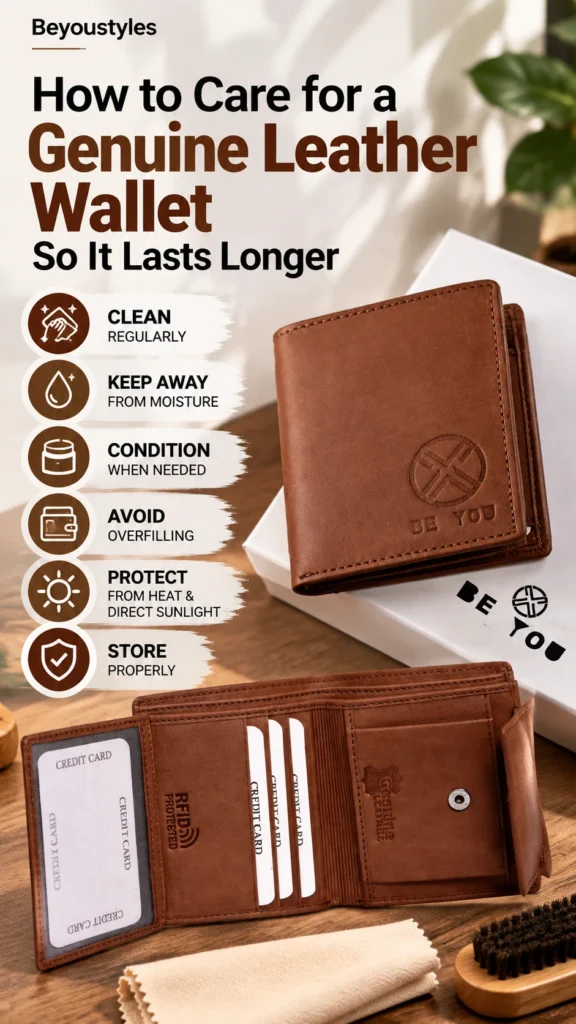
A genuine leather wallet is designed to handle everyday use, but that doesn’t mean it should be ignored once it goes into your pocket. Daily contact with hands, clothing, moisture, dust, pressure and the contents inside the wallet can gradually affect both the leather and its shape.
This guide explains how to care for a genuine leather wallet properly, what to avoid, when leather conditioning may be appropriate and how everyday carrying habits can affect your wallet over time.
Why Does a Genuine Leather Wallet Need Care?
Leather is a natural material. Unlike many synthetic surfaces, genuine leather can change gradually as it is handled and used.
A wallet also experiences more daily contact than many other leather accessories. It may be opened repeatedly, placed on different surfaces, carried inside a pocket and filled with cards, cash, receipts and coins.
Over time, poor care can contribute to:
- Surface dirt and dust
- Dryness
- Loss of shape
- Stretched card slots
- Pressure on stitching
- Scratches and marks
- Uneven appearance
- Unnecessary bulk
A well-made full-grain wallet is designed for regular use, but good maintenance can help it age more naturally.
For example, the Beyoustyles Dark Black Pure Leather RFID Wallet for Men is handcrafted from 100% full-grain genuine leather and designed for everyday carry. Caring for natural leather correctly helps protect the craftsmanship you’re paying for.
1. Start by Emptying Your Wallet
Before cleaning a leather wallet, remove everything from it.
Take out:
- Credit and debit cards
- Identification cards
- Cash
- Receipts
- Coins
- Business cards
- SIM cards
- Other small items
Emptying the wallet allows you to reach the folds, corners, card slots and internal compartments properly.
It also protects cards and documents from accidental contact with moisture or cleaning products.
2. Remove Surface Dust Gently
You usually don’t need aggressive cleaning to remove everyday surface dust.
Start with a clean, soft and dry cloth. Gently wipe the outer leather, paying particular attention to:
- Folded edges
- Corners
- Stitching
- Card-slot openings
- Creases
A soft-bristled brush may help remove dry dust from difficult areas, but it should be used gently to avoid marking the leather.
Regular light cleaning is preferable to allowing dirt to accumulate and then trying to remove it with aggressive products.
3. How to Clean a Genuine Leather Wallet
If dry wiping isn’t enough, use a cleaner specifically suitable for the type and finish of leather used in your wallet.
Always follow the cleaner manufacturer’s directions and the wallet manufacturer’s care instructions.
A sensible process is:
- Remove everything from the wallet.
- Wipe away loose dust with a soft dry cloth.
- Test the leather cleaner on a small, inconspicuous area.
- Apply a small amount of cleaner to a soft cloth rather than pouring it directly onto the wallet.
- Clean gently without soaking the leather.
- Remove any excess product according to its instructions.
- Allow the wallet to dry naturally.
Different leather finishes can react differently to cleaning products, so patch testing is particularly important.
4. Never Soak a Leather Wallet
More water does not mean better cleaning.
Excessive moisture can affect the appearance, feel and shape of leather. Water can also reach the wallet’s internal layers, lining and stitching.
A leather wallet should therefore be cleaned with controlled amounts of moisture rather than being soaked or submerged.
Avoid washing genuine leather wallets in a washing machine or placing them under running water.
5. Let the Wallet Dry Naturally
After cleaning or accidental exposure to moisture, allow your wallet to dry naturally in a ventilated area at room temperature.
Avoid trying to speed up drying with:
- Hair dryers
- Radiators
- Space heaters
- Hot air vents
- Strong direct sunlight
Excessive heat can remove moisture from natural leather too quickly and may contribute to stiffness, distortion or cracking.
Natural drying requires more patience, but it is much safer for genuine leather.
6. What Should You Do If Your Leather Wallet Gets Wet?
Accidents happen. Rain, spilled drinks or damp clothing can expose a wallet to moisture.
If your leather wallet gets wet:
- Remove all cards, cash and other contents.
- Use a clean absorbent cloth to blot excess moisture gently.
- Do not rub the wet leather aggressively.
- Keep the wallet open slightly so air can reach the interior.
- Allow it to dry naturally at room temperature.
- Keep it away from artificial heat.
- Inspect the leather after it has completely dried.
If the leather feels unusually dry after drying, an appropriate leather conditioner may be worth considering.
7. Should You Condition a Leather Wallet?
Leather can gradually lose moisture through everyday use, cleaning and environmental exposure.
A suitable leather conditioner may help maintain flexibility when the leather begins to feel dry.
However, conditioning should not become an automatic weekly routine.
Too much conditioner can:
- Darken some leather finishes
- Leave unwanted residue
- Create a sticky surface
- Attract additional dirt
- Oversaturate the leather
Use a conditioner compatible with your wallet’s specific leather and finish, and always test it first on a hidden area.
8. How to Condition a Genuine Leather Wallet
If conditioning is appropriate for your wallet, begin only after the leather is clean and completely dry.
Then:
- Choose a conditioner designed for the wallet’s leather type.
- Patch-test it on an inconspicuous area.
- Place a small amount onto a clean soft cloth.
- Apply a thin, even layer using gentle movements.
- Avoid saturating the leather.
- Allow the product to absorb according to its instructions.
- Buff gently with a separate clean cloth if recommended.
The goal is light maintenance—not covering the wallet in product.
9. How Often Should You Condition a Leather Wallet?
There is no universal conditioning schedule that applies to every genuine leather wallet.
How often conditioning may be required depends on factors such as:
- Leather type
- Leather finish
- Frequency of use
- Climate
- Humidity
- Exposure to heat
- How the wallet is stored
Instead of conditioning according to an arbitrary calendar, inspect the leather periodically.
If it remains flexible and looks healthy, unnecessary conditioning may do more harm than good.
10. Avoid Overfilling Your Leather Wallet
One of the simplest ways to extend the useful life of a wallet is to stop carrying unnecessary items.
Overfilling places additional pressure on:
- Card slots
- Fold lines
- Stitching
- Edges
- Coin pockets
- Internal compartments
Stuffing too many cards into one slot can gradually stretch the leather. Large stacks of receipts can distort the wallet’s shape, while excessive coins add bulk and pressure.
Carry what you actually use and remove unnecessary receipts, expired cards and old papers regularly.
This is particularly important with compact bifold designs. Our bifold leather wallet buying guide explains why choosing the right capacity is important for comfortable everyday carry.
11. Don’t Sit on an Overfilled Wallet
Carrying a thick wallet in a back pocket and sitting on it for long periods can place constant pressure on the wallet.
This pressure can:
- Distort the wallet’s shape
- Stress the fold
- Place additional strain on stitching
- Bend cards
- Stretch compartments
If possible, consider carrying your wallet in a front pocket, jacket pocket or protected compartment inside a bag—particularly when travelling or sitting for long periods.
12. Keep Your Wallet Away from Harsh Chemicals
Household products should not automatically be treated as leather cleaners.
Avoid applying products such as:
- General household cleaners
- Bleach
- Strong detergents
- Alcohol-based cleaners
- Hand sanitiser
- Unverified stain removers
Products designed for other surfaces can damage or alter leather finishes.
Use leather-specific products that are suitable for the particular leather used in your wallet.
13. Protect Your Wallet from Excessive Sunlight and Heat
Leaving a leather wallet in strong direct sunlight or near a heat source for extended periods can affect the material.
This can happen when a wallet is left:
- On a vehicle dashboard
- Near a window in strong sunlight
- Next to a radiator
- Close to a heater
- In another unusually hot location
When you’re not using the wallet, a cool, dry environment is generally preferable.
14. How to Store a Genuine Leather Wallet
If you’re changing wallets or won’t be using one for an extended period, store it properly rather than leaving it compressed inside a drawer.
Before storage:
- Remove all cards, coins, cash and receipts.
- Clean away surface dust.
- Make sure the wallet is completely dry.
- Store it in a breathable cotton pouch or soft dust bag.
- Keep it somewhere cool and dry.
- Avoid placing heavy objects on top of it.
Avoid sealing leather inside airtight plastic for extended periods, particularly if there is any possibility of trapped moisture.
15. Maintain the Wallet’s Natural Shape
A wallet is designed to hold everyday essentials, but it shouldn’t be used as unlimited storage.
To help maintain its shape:
- Use the card slots as intended.
- Don’t force several cards into a slot designed for one.
- Remove unnecessary receipts regularly.
- Avoid excessive coin storage.
- Don’t fold the wallet in the wrong direction.
- Store it flat without heavy pressure.
Good organization isn’t just convenient—it can reduce unnecessary strain on the leather and stitching.
16. Take Care Around the Stitching
Leather gets much of the attention, but stitching is also essential to wallet durability.
Seams around card slots, edges, coin pockets and fold areas experience repeated movement.
When cleaning, avoid aggressive rubbing around the stitching. Also avoid pulling loose threads if you notice one.
A well-constructed wallet should use strong, even stitching, but proper use still helps reduce unnecessary stress.
Our guide to durable leather accessories for men explains why leather quality, stitching and construction should be considered together when evaluating a wallet.
17. Full-Grain Leather Can Develop Character with Use
Natural full-grain leather should not necessarily remain visually identical throughout its entire life.
Because the natural grain is retained, genuine full-grain leather may gradually develop variations in tone, texture and character through regular handling.
This natural ageing should not automatically be confused with damage.
Small variations in grain and texture are also normal characteristics of authentic natural leather rather than signs that every wallet must look perfectly identical.
This is one reason detailed material information matters when you’re buying a wallet.
For help comparing leather quality, storage and everyday functionality, see our guide on what to look for when buying a genuine leather wallet for men.
18. Leather Wallet Care Mistakes to Avoid
Many wallet-care problems come from doing too much rather than too little.
| Care Mistake | Better Approach |
|---|---|
| Soaking the wallet | Use controlled moisture and a suitable leather cleaner. |
| Using a hair dryer | Allow leather to dry naturally at room temperature. |
| Applying household cleaner | Use products specifically suitable for leather. |
| Conditioning constantly | Condition only when appropriate for the leather and its condition. |
| Carrying too many cards | Keep only regularly used cards and essentials. |
| Leaving old receipts inside | Clean out the wallet regularly. |
| Sitting on an overfilled wallet | Reduce bulk or use another carrying position. |
| Leaving it in direct sunlight | Store it in a cool, dry location. |
| Using excessive conditioner | Apply only a small amount when required. |
19. A Simple Leather Wallet Maintenance Routine
You don’t need an elaborate maintenance schedule to look after a quality leather wallet.
A practical routine can be as simple as:
Regularly
- Remove old receipts.
- Remove unnecessary cards.
- Check for dirt around edges and folds.
- Avoid overfilling.
When Dust or Dirt Appears
- Empty the wallet.
- Wipe gently with a clean soft cloth.
- Use an appropriate leather cleaner only when necessary.
When Leather Feels Dry
- Confirm that conditioning is suitable for the leather.
- Patch-test the product.
- Apply a small amount.
- Allow it to absorb according to the instructions.
For Long-Term Storage
- Empty the wallet completely.
- Make sure it is clean and dry.
- Use a breathable pouch.
- Store away from heat, sunlight and humidity.
20. Why Wallet Quality Matters Before Care Even Begins
Maintenance can help protect a quality wallet, but care cannot transform poor materials and construction into premium craftsmanship.
Before buying, check:
- Leather type
- Leather construction
- Stitching quality
- Edge finishing
- Card-slot construction
- Fold construction
- Storage layout
- Overall size
- Features you genuinely need
Choose the wallet according to your everyday carry requirements rather than filling an unsuitable wallet beyond its intended capacity.
Care for Your Beyoustyles Genuine Leather Wallet
The Beyoustyles Dark Black Pure Leather RFID Wallet for Men is handcrafted from 100% full-grain genuine leather and designed for long-term everyday carry.
Its practical features include:
- 100% full-grain genuine leather
- Handcrafted construction
- Built-in RFID-blocking protection
- Multiple card slots
- Transparent ID window
- Cash compartments
- Secure coin pocket
- Dedicated SIM card storage
- Slim vertical bifold design
- Matte dark black finish
Good maintenance helps protect the natural leather while sensible everyday organization reduces unnecessary pressure on the wallet’s compartments and stitching.
Explore Genuine Leather Wallets for Men
Different men carry different combinations of cards, cash, coins and identification. If you need another configuration, explore the Beyoustyles Genuine Leather Wallets for Men collection.
The collection includes black and brown leather wallets, RFID-protected designs, bifold wallets, coin-pocket wallets, card holders and other everyday-carry configurations.
Frequently Asked Questions About Leather Wallet Care
How do you clean a genuine leather wallet?
Empty the wallet, remove surface dust with a clean soft cloth and use a leather cleaner suitable for the specific finish when necessary. Apply small amounts and avoid soaking the leather. Always patch-test first.
Can you wash a leather wallet with water?
A genuine leather wallet should not be soaked or washed under running water. Excess moisture can affect the leather, shape, stitching and internal construction.
Should I condition my leather wallet?
Conditioning may be appropriate when compatible leather begins to feel dry, but the correct product and frequency depend on the leather type and finish. Always follow the manufacturer’s instructions and patch-test first.
How often should I condition a genuine leather wallet?
There is no universal schedule. Climate, frequency of use, leather type and condition all matter. Inspect the wallet and condition it only when appropriate rather than automatically applying conditioner frequently.
What should I do if my leather wallet gets wet?
Remove its contents, blot excess moisture gently and allow the wallet to dry naturally at room temperature. Avoid hair dryers, radiators and other direct heat sources.
How can I stop my wallet from stretching?
Avoid overfilling card slots and compartments. Remove expired cards, old receipts and unnecessary items regularly, and choose a wallet with enough capacity for what you actually carry.
Can I use hand sanitiser to clean a leather wallet?
Alcohol-based products can affect some leather finishes and should not be used as a general leather cleaner. Use a product specifically suitable for your wallet’s leather.
How should I store a leather wallet?
Empty and clean the wallet, ensure it is dry and store it in a breathable pouch in a cool, dry location away from strong sunlight, excessive heat and humidity.
Does full-grain leather change with age?
Yes. Natural full-grain leather can gradually develop variations in tone, texture and character through regular handling and use. Proper care can help it age naturally while maintaining its functionality.
Final Thoughts
Good leather wallet care is mostly about sensible everyday habits rather than constant treatment.
Keep your wallet clean, don’t overload it, protect it from excessive moisture and heat, allow wet leather to dry naturally and use suitable leather-care products only when necessary.
Just as importantly, start with a well-constructed wallet made from quality leather and choose a design with enough capacity for the cards, cash and other essentials you actually carry.
A genuine leather wallet will naturally develop character as it is used. With appropriate care and responsible everyday use, you can help preserve its shape, appearance and functionality for much longer.


