
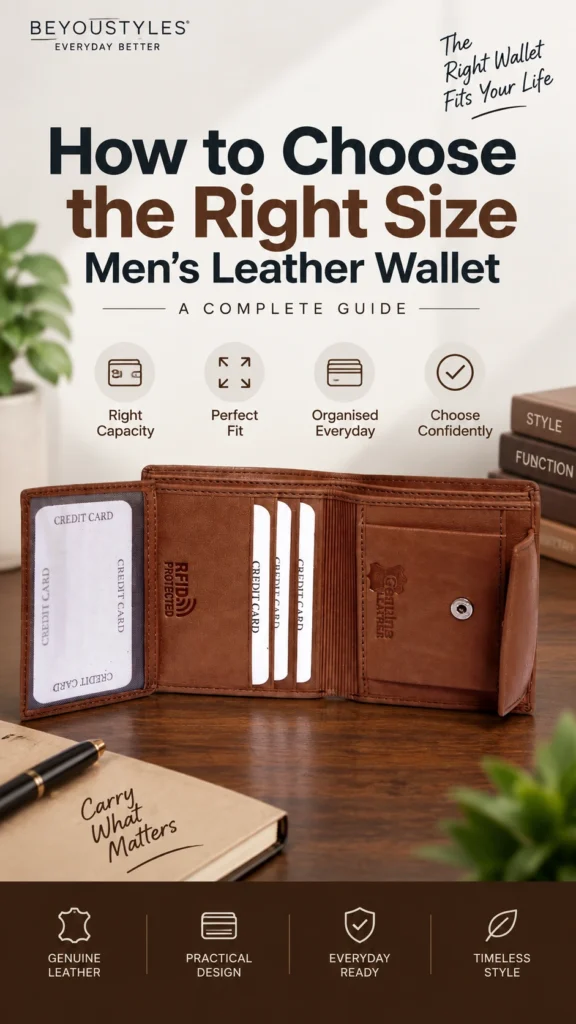
Choosing a wallet is not only about leather quality, colour or design. Wallet size can make a major difference to how comfortably it fits in your pocket, how easily you can organise your essentials and how bulky it feels during everyday use.
A wallet that is too small may not hold the cards and cash you regularly carry. A wallet that is too large can become unnecessarily bulky, particularly when carried in a trouser pocket. The right choice depends on what you actually carry and where you normally keep your wallet.
This men’s wallet size guide explains how to choose the right leather wallet size, what dimensions really mean, how card capacity affects thickness, and when a slim, bifold or larger wallet may be the better choice for your needs.
Why Does Men’s Wallet Size Matter?
A leather wallet is something many men carry almost every day. Because it stays in a pocket for hours at a time, even a relatively small difference in size or thickness can affect comfort.
The ideal wallet should provide enough space for your regular essentials without encouraging you to carry items you rarely use.
Choosing the correct size can help you:
- Keep everyday cards organised
- Carry cash without unnecessary bulk
- Fit the wallet comfortably into your preferred pocket
- Access frequently used cards more easily
- Avoid overfilling the wallet
- Choose a design that matches your actual carrying habits
Before choosing a wallet based on appearance alone, it is therefore worth thinking about its dimensions, internal layout and capacity.
What Is the Standard Size of a Men’s Wallet?
There is no single universal size that every men’s wallet follows. Dimensions vary according to wallet style, construction and internal features.
A minimalist card wallet, for example, can be considerably smaller than a traditional bifold. A wallet containing a coin pocket, additional card slots or an ID section may need more internal space and can therefore be thicker or slightly larger.
Instead of searching for one “standard” measurement, it is more useful to ask:
- How many cards do I normally carry?
- Do I regularly carry cash?
- Do I need a coin pocket?
- Do I carry an ID card?
- Which pocket will I use for the wallet?
- Do I prefer minimum bulk or more storage?
Your answers to these questions will usually tell you more than the external dimensions alone.
Understand Wallet Dimensions Before Buying
When looking at wallet measurements online, remember that a closed wallet and an open wallet have different dimensions. For everyday pocket comfort, the closed dimensions are generally the most useful measurements to consider.
Three characteristics deserve particular attention:
Wallet Width
Width affects how the wallet sits across your pocket. A very wide wallet may feel awkward in narrower trousers even if the wallet itself is relatively thin.
Wallet Height
Height affects pocket fit and how easily you can insert or remove the wallet. It can also be influenced by the internal arrangement of card slots and cash compartments.
Wallet Thickness
Thickness is particularly important because a wallet becomes thicker after you fill it. A slim empty wallet can become bulky when overloaded with cards, receipts and coins.
For that reason, never evaluate a wallet’s practical size based only on how thin it looks when empty.
Choose Wallet Size According to What You Carry
The easiest way to choose the right size is to examine your current wallet before buying another one.
Take everything out and divide the contents into three groups:
- Daily essentials: cards, identification and cash you regularly use
- Occasional items: cards or documents you rarely need
- Unnecessary items: expired cards, old receipts and other things that do not need to stay in your wallet
Now choose your new wallet according to the first group rather than everything that happened to accumulate in your old wallet.
This simple approach can help you choose a smaller and more practical wallet without sacrificing useful storage.
How Many Card Slots Do You Really Need?
Card capacity is one of the most important parts of a men’s wallet size guide.
Many buyers assume that more card slots automatically make a wallet better. In practice, extra capacity is useful only when you actually need it.
If you carry only a few essential cards, a slim leather wallet may provide enough capacity while keeping pocket bulk to a minimum. If you regularly carry several bank cards, identification and other essential cards, a bifold with additional card slots may be more practical.
Also remember that the number of visible slots does not necessarily tell you everything about capacity. Some wallets include additional internal sections behind the main card slots.
Should You Put More Than One Card in a Wallet Slot?
Unless the wallet is specifically designed for multiple cards in one compartment, repeatedly forcing several cards into a single slot can place unnecessary stress on the leather and stitching.
Leather can adapt with use, but deliberately overloading a wallet from the beginning can distort its intended shape.
A better approach is to choose a wallet with enough dedicated capacity for the cards you genuinely need.
Slim Wallet vs Bifold Wallet: Which Size Is Better?
There is no universally correct answer. A slim wallet and a traditional bifold wallet serve somewhat different carrying preferences.
| Feature | Slim Wallet | Bifold Wallet |
|---|---|---|
| Best suited to | Essential cards and reduced bulk | Cards, cash and broader everyday storage |
| Pocket profile | Generally more compact | Depends on capacity and contents |
| Card storage | Usually focused on essentials | Often provides more organisation |
| Cash storage | Depends on design | Commonly includes a dedicated note section |
| Best choice when | You deliberately carry less | You want traditional everyday organisation |
If minimum pocket bulk is your priority, start with a slim design. If you need several cards and regularly carry cash, a bifold may offer a more practical balance between size and capacity.
Does a Coin Pocket Make a Wallet Bigger?
A dedicated coin compartment requires additional material and internal space, so a leather wallet with coin pocket can have a different profile from a minimalist wallet.
That does not make it too large. It simply means the wallet has been designed for a different purpose.
If you regularly carry coins, choosing a dedicated coin-pocket wallet can be more practical than putting loose coins into compartments that were designed for cards or notes.
If you almost never carry coins, however, you may prefer to use that space for a slimmer overall design.
Does RFID Protection Change Wallet Size?
An RFID leather wallet for men is designed with RFID-blocking functionality, but RFID should be considered separately from your basic capacity requirements.
Start by choosing the wallet layout you actually need—such as the number of card slots, cash storage and overall style—and then compare RFID-equipped options within that format.
This prevents a useful feature from distracting you from the more fundamental question: Will this wallet comfortably hold what I carry every day?
Front Pocket vs Back Pocket Wallet Size
Where you carry your wallet should influence the size you choose.
Front Pocket
A front-pocket wallet generally benefits from a compact profile because available space can be more limited. Men who prefer front-pocket carry often prioritise essential cards and reduced thickness.
Back Pocket
A traditional bifold can fit naturally into many back pockets, but filling it with unnecessary cards, receipts and coins can quickly increase thickness.
Jacket or Bag
If your wallet normally stays in a jacket pocket or bag, you may have greater flexibility in terms of dimensions and capacity. This can make additional storage more practical if you genuinely use it.
How Thick Should a Men’s Wallet Be?
There is no ideal thickness that suits every man because thickness changes according to both wallet construction and contents.
The more useful principle is to buy enough capacity for your everyday essentials without leaving excessive unused storage that encourages clutter.
Consider two measurements:
- Empty thickness: how the wallet is constructed before use
- Loaded thickness: how it feels after adding your normal cards, notes and other essentials
The second measurement is what ultimately affects everyday pocket comfort.
Does Leather Thickness Affect Wallet Size?
Yes. Leather itself contributes to the final structure and thickness of a wallet.
A leather wallet contains multiple pieces of material for the outer shell, card sections, note compartments and other features. The way these pieces are cut, layered and stitched affects the final profile.
This is one reason two wallets with similar external dimensions can feel different once you hold and use them.
Why You Should Not Overfill a Leather Wallet
Buying the correct wallet size is only part of the solution. How you use the wallet matters too.
Continually adding cards, receipts, coins and folded papers can make even a well-sized wallet bulky. Overfilling can also place additional pressure on card slots, folds and stitching.
Try to remove unnecessary contents regularly. A leather wallet works best when used within the capacity its design is intended to provide.
How to Choose a Wallet Size for Cash
If you regularly carry cash, examine the wallet’s note compartment rather than focusing only on card slots.
A practical cash section should allow the notes you normally use to sit inside the wallet as intended. Constantly forcing or excessively folding notes simply to fit them into a wallet may indicate that the design does not match your carrying habits.
If you rarely use cash, on the other hand, you may prefer a design that allocates more of its space to cards rather than a large note compartment.
How to Choose the Right Wallet Size Online
Shopping online means you cannot put the wallet into your pocket before ordering, so product specifications become particularly important.
Before buying, check:
- Closed dimensions of the wallet
- Number of card slots
- Cash compartment layout
- ID window, if required
- Coin pocket, if required
- RFID functionality, if it is important to you
- Product photographs showing the internal layout
- Leather and construction details
Rather than choosing the wallet with the highest number of features, choose the combination of dimensions and storage that most closely matches your normal use.
What Size Wallet Is Best for Everyday Use?
For most buyers, the best everyday wallet is not necessarily the smallest or the largest. It is the wallet that holds normal essentials comfortably while remaining manageable when fully loaded.
A practical everyday wallet should give you enough room for the items you use regularly without turning into storage for old receipts, unused cards and miscellaneous papers.
You can explore the Beyoustyles Leather Wallets for Men collection to compare different wallet layouts and choose according to your everyday carrying requirements.
Does Wallet Colour Affect the Size You Should Choose?
No. Colour and size represent different purchase decisions.
A black leather wallet for men and a brown leather wallet for men can use similar dimensions while offering different visual styles. Choose the size according to capacity and pocket preference, then choose the colour and finish you prefer.
This distinction is particularly useful when shopping online because it prevents appearance from becoming the only factor in your decision.
Men’s Wallet Size Guide: Quick Checklist
Before choosing your next leather wallet, ask yourself:
- How many cards do I genuinely use?
- Do I regularly carry cash?
- Do I need a separate coin pocket?
- Do I need an ID window?
- Is RFID functionality important to me?
- Will I carry the wallet in a front or back pocket?
- Do I prefer a slim or traditional bifold design?
- What are the wallet’s closed dimensions?
- How thick will it become when loaded?
- Am I buying useful capacity or unnecessary extra space?
Answering these questions before buying makes it much easier to select the right wallet size.
Frequently Asked Questions About Men’s Wallet Sizes
What is the best size wallet for men?
There is no single best wallet size for every man. The right size depends on the number of cards you carry, whether you use cash or coins, your preferred pocket and whether you favour a slim or higher-capacity design.
Are slim wallets better than regular wallets?
Slim wallets are useful for people who intentionally carry fewer items. Traditional bifold wallets may be more practical for men who need additional card and cash organisation. The better option depends on your actual requirements.
How many cards should a men’s wallet hold?
Choose capacity according to the number of cards you regularly use rather than trying to maximise the number a wallet can hold. Extra unused capacity can encourage unnecessary bulk.
Should a wallet be tight when new?
A new leather wallet can feel structured, but cards should be used according to the intended capacity of each slot. Avoid forcing excessive cards into a compartment simply to stretch it.
Is a bifold wallet too bulky?
Not necessarily. Bifold wallets can provide a practical balance of cash and card storage. Much of the eventual bulk comes from what is placed inside the wallet rather than the bifold format alone.
Is a coin-pocket wallet bigger?
A coin compartment requires additional space and construction, so it can affect the wallet’s profile. If you regularly carry coins, however, that additional space can provide useful organisation.
What wallet size is best for a front pocket?
A compact or slim design is generally easier to accommodate when front-pocket space is limited. The exact choice should still be based on your pocket dimensions and the cards or cash you need to carry.
Should I choose wallet size based on colour?
No. First choose the appropriate size, capacity and internal layout. You can then select black, brown, espresso or another finish according to your style preference.
Final Thoughts: Choosing the Right Men’s Leather Wallet Size
The right wallet size is ultimately determined by what you carry, how you organise it and where you keep your wallet.
If you carry only essential cards, a slim wallet can help reduce unnecessary pocket bulk. If you regularly use cash and several cards, a traditional bifold may provide more practical organisation. If coins are part of your everyday carry, a dedicated coin compartment can be worth the additional space.
Most importantly, avoid choosing a wallet simply because it has the highest number of slots. A well-chosen leather wallet should provide enough capacity for your real everyday requirements while remaining comfortable and organised.
By checking dimensions, card capacity, cash storage and internal features before buying, you can choose a men’s leather wallet that fits both your pocket and your daily routine.


