Buying a leather belt sounds simple until you start seeing terms such as real leather, genuine leather, faux leather, PU leather, bonded leather, and full-grain leather. Some synthetic belts can look convincing in photos, which makes it difficult to know exactly what you are buying.
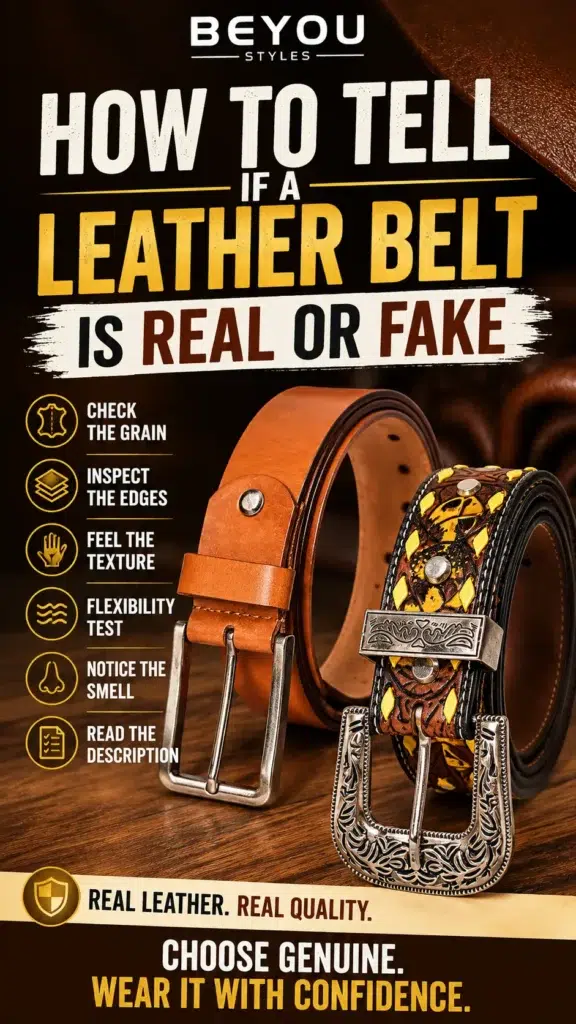
So, how do you tell if a leather belt is real? Instead of relying on one test, check several details together: the grain, texture, edges, flexibility, smell, surface variation, construction, and product description.
If authentic material is important to you, start by choosing a clearly described genuine leather belt for men rather than buying solely on appearance.
Why Does Real Leather Matter in a Belt?
A belt goes through considerable stress during everyday wear. It bends around your waist, passes through belt loops, moves around the buckle, and experiences repeated pressure around the adjustment holes.
That makes material quality especially important.
Real leather is a natural material. Its surface, grain, and character can vary, whereas synthetic materials are manufactured and can have a more repetitive appearance.
Knowing what to inspect can help you make a better buying decision and avoid paying leather prices for a synthetic product.
1. Examine the Leather Grain Closely
Start by looking carefully at the surface of the belt.
Real leather may contain subtle variations in grain, pores, texture, and natural markings. Because it comes from an animal hide, every section does not necessarily look perfectly identical.
Artificial leather is manufactured, so its grain pattern can sometimes look unusually regular or repetitive.
However, modern synthetic materials can imitate natural grain very effectively. Grain should therefore be treated as one clue rather than absolute proof.
2. Look at the Belt’s Edges
The edges of a belt can provide useful information about its construction.
Leather has a naturally fibrous internal structure. On an unfinished or lightly finished edge, you may be able to see or feel some of this texture.
Some synthetic belts may reveal a smoother artificial layer or fabric-like backing beneath the surface coating.
Keep in mind that a well-finished leather belt can have painted, sealed, or polished edges, so the internal material may not always be visible.
3. Feel the Texture
Touch is another useful test when you can inspect a belt in person.
Natural leather commonly has slight differences in texture across its surface. Depending on the leather and finish, it may feel smooth, grainy, firm, supple, or waxy.
Some artificial leather feels unusually plastic-like or consistently smooth from one end to the other.
But because synthetic leather has improved considerably, texture alone should not determine your decision.
4. Gently Flex the Belt
A quality belt needs to flex naturally around the waist.
When genuine leather is gently bent, you may notice subtle changes in its grain or surface appearance. The material should generally feel firm while still allowing natural movement.
A synthetic belt may behave differently depending on its backing and coating.
Do not sharply fold or aggressively bend a new belt just to test it. Excessive force can permanently crease or damage almost any belt.
5. Check for Natural Surface Variations
Perfect uniformity can sometimes be a clue that you are looking at a manufactured surface.
Real leather can contain minor variations in colour, grain, pores, and markings. These characteristics can give genuine leather its individual appearance.
Natural variation does not mean poor quality. In many cases, it is part of what makes real leather distinctive.
6. Smell Can Be a Clue, But Not Proof
Real leather often has a recognizable natural leather smell, while some synthetic materials can have a chemical or plastic-like odour.
However, this test is far from perfect.
Dyes, conditioners, packaging, coatings, adhesives, and manufacturing treatments can all affect how a belt smells. Some synthetic products can also be treated with fragrances designed to resemble leather.
Use smell only as an additional clue.
7. Read the Material Description Carefully
When buying online, the product description becomes especially important because you cannot physically inspect the belt before ordering.
Look for clear information about:
- The type of leather used
- Leather construction
- Belt width
- Buckle material and style
- Available sizes
- Surface finish
- Stitching and edge construction
A detailed description gives you much more useful information than a product page that simply says “premium belt” without explaining the material.
8. Understand What “Genuine Leather” Means
The terminology surrounding leather can be confusing.
Consumers sometimes assume that every leather-related term represents exactly the same construction or grade. In reality, leather products can differ considerably depending on the hide, processing method, surface treatment, thickness, and construction.
That is why you should evaluate the entire product rather than judging quality from one marketing phrase.
If you want additional guidance before purchasing, read our complete guide to genuine leather belts for men.
9. Check the Buckle and Overall Construction
Authenticity is important, but a good belt also depends on construction.
Look at how securely the buckle is attached, whether the edges are neatly finished, whether the holes are cleanly cut, and whether the belt feels substantial enough for its intended use.
A genuine leather strap combined with poor hardware or weak construction can still result in a disappointing belt.
10. Be Careful With Prices That Look Too Good to Be True
Price alone cannot prove whether a belt is genuine or fake.
Leather prices vary according to material, construction, brand, hardware, design, manufacturing location, and many other factors.
However, if a product claims premium leather construction while being sold at an unusually low price, examine the material description carefully before buying.
Real Leather vs Fake Leather Belt: Key Differences
When comparing belts, look at several characteristics rather than searching for one perfect authenticity test.
- Surface: Real leather may show natural grain variation; synthetic leather can appear more uniform.
- Texture: Genuine leather can have subtle differences across the surface.
- Edges: Exposed real leather can show a fibrous internal structure.
- Flexibility: Leather generally develops natural movement through use.
- Smell: Real leather may have a recognizable natural aroma, although this is not a reliable test by itself.
- Aging: Natural leather can develop character as it is used and cared for.
- Product information: A trustworthy description should clearly explain the belt’s materials and construction.
Does Real Leather Age Differently?
One reason many people choose leather accessories is how the material changes with use.
Depending on the type and finish, real leather can develop subtle character over time rather than simply maintaining a perfectly uniform manufactured surface.
Proper care matters as well. Leather should be protected from unnecessary moisture, excessive heat, harsh chemicals, and poor storage conditions.
For more background on authentic leather belts and their everyday value, see our existing guide to real leather belts for men.
How to Check a Leather Belt When Shopping Online
You obviously cannot touch, smell, or flex a belt when shopping online. That means your evaluation needs to focus on information that can be verified from the product listing.
Before ordering, check:
- Material description
- Close-up product photographs
- Edge and buckle photographs
- Belt width
- Available sizes
- Product specifications
- Care information
- Seller and brand information
Do not make your decision based only on a highly edited product photograph. Material specifications are much more important when authenticity is your priority.
What to Look for in a Genuine Leather Belt for Men
Once you are satisfied with the material, consider whether the belt actually suits your needs.
A useful everyday leather belt should offer a balance of:
- Authentic leather construction
- Comfortable thickness
- Reliable buckle
- Clean edge finishing
- Appropriate width
- Correct size
- Versatile colour
- Construction suitable for regular wear
If your priority is an authentic belt for everyday outfits, choose a real leather belt for men with clearly stated materials and specifications.
Real Leather Belts for Casual and Formal Wear
The right belt should also suit the clothing you plan to wear.
Black leather belts generally work particularly well with formal trousers, business clothing, and darker footwear. Brown and tan shades can pair naturally with denim, chinos, boots, and more relaxed outfits.
Texture and buckle style also influence whether a belt looks formal or casual. Smooth leather with a restrained buckle tends to appear more formal, while textured leather and larger hardware usually create a more casual look.
Why Buying the Correct Belt Size Matters
Even an authentic leather belt will not perform properly if the size is wrong.
A belt that is too short can put excessive pressure on the adjustment holes, while one that is too long can leave too much material extending beyond the first belt loop.
Always check the product’s sizing information before ordering instead of assuming your trouser size automatically matches every belt manufacturer’s sizing system.
Explore Genuine Leather Belts for Men
Once you know how to distinguish natural leather characteristics from synthetic alternatives, choosing a belt becomes easier.
You can browse the complete Genuine Leather Belts for Men collection at Beyoustyles to compare different colours, finishes, buckle styles, and designs.
Final Thoughts
Learning how to tell if a leather belt is real is not about finding one secret test. The most reliable approach is to evaluate several characteristics together.
Inspect the grain, texture, edges, flexibility, surface variation, product specifications, buckle, and overall construction. When shopping online, pay particular attention to clear material descriptions and detailed product information.
Most importantly, keep the purpose of the belt in mind. Authentic material matters, but the right size, construction, buckle, colour, and style determine whether that belt will actually work well in your wardrobe.
Frequently Asked Questions
How can I tell if a leather belt is real?
Check several characteristics together, including surface grain, natural variations, texture, edges, flexibility, construction, and the manufacturer’s material description. No single home test is completely reliable.
Does real leather have a unique smell?
Real leather often has a recognizable natural aroma, but smell alone cannot prove authenticity because dyes, conditioners, coatings, packaging, and synthetic fragrances can alter a belt’s smell.
Does real leather have imperfections?
Natural leather can contain subtle differences in grain, pores, colour, and markings because it originates from animal hide. The appearance depends on how the leather has been processed and finished.
Can fake leather look like real leather?
Yes. Modern synthetic materials can imitate natural leather surprisingly well, which is why buyers should examine multiple characteristics and carefully read the material specifications.
Is a real leather belt good for everyday wear?
A well-constructed leather belt can be an excellent everyday accessory when its material, size, buckle, width, and style are appropriate for how you intend to wear it.
Where can I buy genuine leather belts for men?
Beyoustyles offers a collection of genuine leather belts for men in different colours, finishes, and styles for casual and dress wear.