
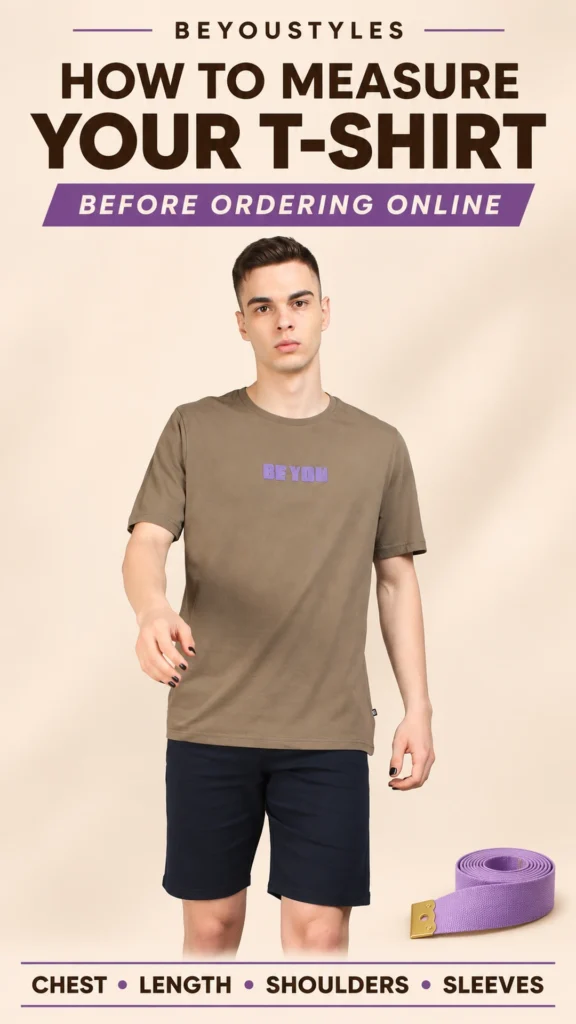
This guide explains how to measure a T-shirt without stretching it or confusing a flat garment width with a body measurement. If you are considering the True Classic Tees White T-Shirt by Beyoustyles, use these steps to prepare your measurements before selecting a size. The listing describes a regular unisex fit, so compare it with a similar tee you already like.
What You Need Before Measuring
- A flexible measuring tape with clear inch or centimetre markings.
- A flat, firm surface large enough for the whole T-shirt.
- A clean, dry T-shirt that fits comfortably after its usual wash routine.
- A place to record the measurements and the method you used.
Choose a reference tee with a similar construction to the one you want to order. A very stretchy fitted sports top may give a misleading comparison for a regular cotton tee. Likewise, a deliberately oversized shirt will help you reproduce an oversized silhouette rather than a closer fit.
Lay the shirt face up and smooth out wrinkles gently. Keep the side seams in their natural position. Do not pull the fabric tight, stretch the collar or force an uneven hem into a different shape. If the shirt has twisted noticeably or lost its shape, choose another reference.
How to Measure a T-Shirt: Four Useful Measurements
1. Measure Chest Width from Armpit to Armpit
With the shirt lying flat, measure straight across the front from one underarm junction to the other. Keep the tape level and the fabric relaxed. Record the result as flat chest width or pit-to-pit width.
This number is not your body chest circumference. For example, a shirt measuring 22 inches across has an approximate garment circumference of 44 inches at that level when doubled. That does not mean it is intended for a 44-inch body chest: the room between the body and the garment affects the fit.
Some brands measure a set distance below the armhole rather than directly at the underarm junction. If the product chart specifies that method, repeat it on your reference tee before comparing.
2. Measure Body Length from the High Shoulder Point
Find the high shoulder point where the shoulder meets the neckline, beside the collar. Measure down towards the hem in a straight line parallel to the centre front, with the garment flat. Record this as high shoulder point to hem.
A centre-back length measured from below the back collar is a different measurement. Do not compare those two numbers directly. For a curved hem, note the point where you ended the measurement and follow the retailer’s diagram if one is available.
Think about how you wear the tee. A length you like tucked into trousers may feel different when worn untucked with shorts. Measure the shirt you reach for in the situation you are shopping for.
3. Measure Shoulder Width Seam to Seam
Turn the tee over if that makes the seams easier to see. Measure straight across between the outer shoulder seam points, where the sleeves join the body. Keep the shoulders flat rather than following a curved route over the fabric.
This works for a conventional set-in sleeve. A raglan sleeve or dropped-shoulder design needs a different interpretation, so compare like constructions where possible. A larger shoulder measurement can reflect the intended design rather than an incorrect size.
4. Measure Sleeve Length from the Shoulder Seam
Lay one sleeve naturally flat. Measure from the outer shoulder seam down the top of the sleeve to its finished edge. Record the starting point along with the number.
Retailers may instead measure from the centre back neck or use another sleeve method. A sleeve length is useful only when both measurements begin and end at equivalent points. If the chart does not explain its method, ask before relying on it.
Keep a Simple T-Shirt Measurement Record
Use this checklist for each reference garment. Take every measurement twice to catch an angled tape or a folded edge.
| Measurement | Your reference tee | Method to confirm on the product chart |
|---|---|---|
| Chest width | Record flat width and units | Pit-to-pit or a stated distance below the armhole |
| Body length | Record length and units | High shoulder point or centre-back starting point |
| Shoulder width | Record seam-to-seam width | Straight across between shoulder seam points |
| Sleeve length | Record length and starting point | Shoulder seam, centre back or another specified method |
If you need to convert units, 1 inch equals 2.54 centimetres. A flat width of 22 inches is 55.88 centimetres. Keep enough precision to compare sensibly, but do not treat a flexible fabric measurement as perfectly exact.
How to Compare Your Measurements with an Online Size Chart
First establish whether the chart describes the garment or the person wearing it. A body chest chart and a flat garment chest chart answer different questions. Doubling a flat width helps interpret garment circumference, but it does not convert that chart into a body-size recommendation.
Next, confirm the units and measurement points. The Beyoustyles Plain White T-Shirt listing includes a size guide labelled in inches with chest, length, shoulder and sleeve columns. Confirm how those columns were measured before matching them to your own notes, especially if “chest” is not explicitly defined as a flat width.
Compare the complete set of dimensions rather than choosing whichever size matches one number. Two tees can share a chest width but have noticeably different lengths and shoulders. If the listed size is close to your favourite tee in all the places that matter to you, it is a more useful comparison than a familiar S, M or L label alone.
For broader buying considerations beyond measurements, see our men’s T-shirt buying guide covering fit, fabric and comfort.
What If You Fall Between Two Sizes?
Identify what you want to change about your current fit. If your reference shirt fits well across the chest but feels too short, simply sizing up may also add width you do not want. Look at the length and shoulder measurements of the next size before deciding.
- For a closer everyday fit: look for measurements near a reference tee that already feels comfortable, without choosing a smaller size that restricts movement.
- For a roomier fit: compare with a roomier tee you own instead of adding an arbitrary amount to every measurement.
- For layering: consider the garment you will wear over or under the tee and check whether the shoulder and sleeve shapes work together.
Product measurements may have a stated manufacturing tolerance. Check for one and ask the retailer if a small difference would determine your choice. Read the current return conditions before ordering when you remain unsure.
Measuring for a Beyoustyles White Cotton T-Shirt
The two featured listings describe 100% cotton, 180 GSM fabric, a biowash finish and a regular unisex fit. These details help identify the type of tee you are comparing, but they do not replace checking the individual size chart.
Use your measurement record when reviewing the True Classic Tees White T-Shirt size options. Check its current photographs and chart, then confirm any unclear measurement conventions before purchasing. This is a Beyoustyles product; use its own sizing information when making your decision.
If you prefer the other listing, compare the same measurements with the Plain White Cotton T-Shirt for men and women. Avoid assuming that similar fabric descriptions guarantee identical sizing across every product.
You can also browse the Beyoustyles T-shirts collection to compare plain T-shirts, round neck styles and other available designs. Apply the same measuring method to each product you shortlist.
Measure a Washed Tee, Then Follow the New Garment’s Care Label
A shirt that fits well after normal washing is usually a more practical reference than one temporarily stretched from wear. Measure it when it is fully dry and relaxed. If you have recently reshaped it while drying, allow it to settle before recording the dimensions.
The featured tees are described as pre-washed and pre-shrunk. That preparation does not guarantee that every future washing or drying method will leave the dimensions unchanged. Follow the care label rather than buying an unsuitable size on the assumption that you can shrink or stretch it into shape.
Our white T-shirt care guide provides further reading on looking after pale cotton basics. Once you have chosen your fit, explore these everyday white T-shirt outfits for men for ways to wear it with pieces you already own.
Your Before-Ordering Checklist
- Choose a dry reference T-shirt with a fit you want to reproduce.
- Measure chest width, body length, shoulders and sleeves without stretching.
- Record the units and the starting and ending points.
- Confirm whether the retailer’s chart uses body or garment measurements.
- Compare all the dimensions and ask about unclear methods or tolerances.
- Review the product details, care instructions and current return conditions.
Frequently Asked Questions
How do I measure a T-shirt chest?
Lay it flat, smooth it without stretching and measure straight across between the underarm junctions. Record this as flat chest width, then check whether the retailer uses the same measurement points.
Should I double a pit-to-pit measurement?
Double it only when you need an approximate garment circumference at that level. Keep the original flat width for comparisons with flat garment charts. Neither number is automatically your body chest size.
Where do I start when measuring T-shirt length?
One common method starts at the high shoulder point beside the collar and runs down to the hem. Follow the seller’s method if it uses a different starting point.
Can I choose the same size I wear in another brand?
Use that label as a starting point, then compare measurements. Size letters alone do not establish chest width, length or the intended silhouette.
Should I size up in a 100% cotton T-shirt?
Decide from the product chart and the fit you want. Cotton composition alone does not tell you to size up. Check the care information and avoid relying on deliberate shrinkage to achieve your preferred fit.